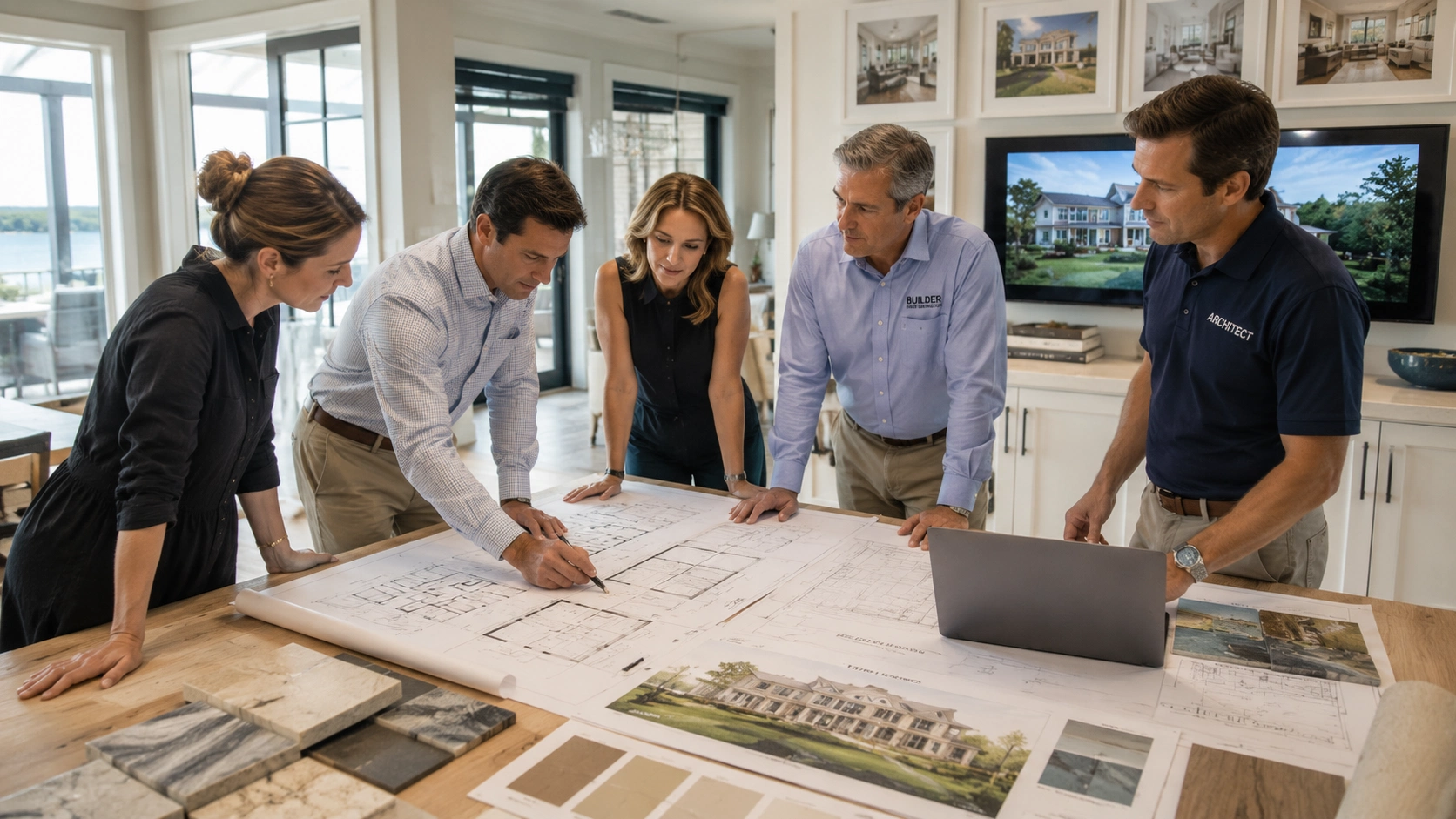
Design-build in the Hamptons is a project delivery method that puts a single firm in charge of both the design and construction of a home under one contract, rather than splitting those responsibilities between an architect and a separate contractor. For luxury projects on the East End, where village-level permitting, coastal regulations, and Architectural Review Boards add real complexity, that single-team structure tends to produce more predictable budgets and fewer delays than the traditional design-then-build approach.
This guide covers how design-build actually works, why it fits the Hamptons market specifically, and how it compares to the alternatives, general contractors, hiring an architect first, and the traditional design-bid-build sequence, each covered in more depth in the related guides linked throughout.
Key Takeaways
- Design-build puts design and construction under a single contract with one accountable team, unlike design-bid-build, which splits those roles between two separate contracts.
- Village-level zoning, Architectural Review Boards, and FEMA flood zone rules make the Hamptons a market where integrated local permitting knowledge has outsized value.
- A design-build engagement typically moves through four phases: consultation and feasibility, concept design and design development, permitting and pre-construction, and construction through certificate of occupancy.
- Budget alignment, mid-project change management, and single-party accountability are the three areas where design-build most clearly outperforms traditional delivery.
- Design-build isn’t the right fit for every project, particularly when a complete architectural design already exists and only construction remains.
- Evaluating whether a firm is genuinely design-build, rather than a contractor with a designer on staff, comes down to who’s in the room when design and cost decisions are actually made.
What Design-Build Actually Means
Design-build is a project delivery method in which a single firm is responsible for both the design and the construction of a home under one contract with the owner. The architect or designer and the construction team work as an integrated unit from the earliest concept stage through the final walkthrough, rather than as separate parties contracted independently.
The contrast is with the traditional design-bid-build model, where an owner first contracts a designer or architect to produce drawings, then takes those drawings out to bid among general contractors, entering a second contract with the builder who wins. How design-build and design-bid-build actually compare runs deeper than contract structure alone, extending to cost certainty, timeline risk, and how changes get handled.
In a design-build arrangement, there is one contract, one point of accountability, and one team whose incentives are aligned around delivering the project rather than protecting two separate scopes of work. Homeowners still deciding between architect vs. design-build firm as a starting point are really asking a version of this same question.
Why the Hamptons Makes Design-Build Worth Considering
Building anywhere in the Hamptons involves a regulatory environment that most other residential markets don’t match. Each village and hamlet, Southampton, East Hampton, Sag Harbor, Bridgehampton, Water Mill, maintains its own building department, zoning code, and in some cases an Architectural Review Board. Coastal properties add FEMA flood zone requirements, erosion hazard setbacks, and Conservation Board review.
In the traditional model, an architect designs to a program and a budget, produces construction documents, and hands them off to a contractor. If a design element doesn’t pass local review or requires a variance the architect didn’t anticipate, the drawings go back for revision, the permit clock resets, and the contractor waits. Neither party owns the delay.
When the builder is part of the design team from the start, local permit knowledge and experience with what has and hasn’t cleared review in specific villages is embedded in the design process rather than applied after the fact. For homeowners splitting time between the Hamptons and another city, the single-team structure also simplifies day-to-day oversight in a way that matters practically, not just theoretically.
How the Design-Build Process Works
From a homeowner’s perspective, a design-build engagement typically moves through four broad phases, each building on the design and cost decisions made in the one before it.
| Phase | What Happens |
| Consultation and Feasibility | The firm evaluates the site, discusses the homeowner’s program and budget, and gives an early assessment of what can be built, at what approximate cost, within what regulatory constraints |
| Concept Design and Design Development | The integrated team develops the architectural vision, refines the floor plan, and produces detailed design documents, with cost modeling running alongside design rather than following it |
| Permitting and Pre-Construction | Drawings are submitted to the relevant building department while the construction team prepares for groundbreaking: executing trade contracts, ordering long-lead materials, and finalizing the schedule |
| Construction Through Certificate of Occupancy | The build proceeds under a single management structure, with the same team accountable for quality, schedule, and budget through final inspections and punch list |
The permitting and pre-construction phase is where most of the groundwork for a smooth build actually gets laid. Firms with a disciplined process typically work from a preconstruction checklist, and increasingly build in a constructability review before drawings are ever finalized.
Where Design-Build Outperforms Traditional Delivery
The advantages of design-build show up most clearly in three situations common on luxury Hamptons projects. Budget alignment is the first: in traditional delivery, an architect designs to an assumed budget, the contractor then prices the completed drawings, and the bid often comes in over the owner’s expectation. When the builder is part of the design team, cost modeling is continuous, with decisions about materials and finishes made against real pricing rather than estimated after the fact.
Mid-project change management is the second, and it’s where the operational difference is most tangible. A homeowner who decides to relocate a kitchen island or reconfigure a guest wing after framing is underway faces a formal change order process involving two separate firms under traditional delivery. In design-build, the same team resolves it internally: the design side adjusts, the construction side prices and schedules, and the homeowner gets a single answer rather than a negotiation.
Accountability is the third. When something goes wrong in traditional delivery, the question of whose scope covers it, the architect’s design decision or the contractor’s construction execution, can produce disputes the homeowner ends up navigating. In design-build, the single contract means a single party owns the outcome.
When Design-Build Might Not Be the Right Fit
Design-build isn’t the right model for every situation, and a firm worth hiring will say so. If you already have a completed architectural design from a firm you’ve worked with for years and want to take those drawings to construction, design-build adds little value in the design phase.
How that scenario compares to hiring a general contractor instead is worth weighing directly, since the right answer depends on how far along the design already is and how much coordination you want to manage yourself, not on which model is universally better.
If competitive bidding matters to you, either because of project scale or personal preference for price tension in the contracting process, the traditional model gives you that. The honest answer is that design-build works best when design and construction decisions are genuinely integrated from the start, not when one party is bolted onto the other.
Things to Know
- A design-build contract typically defines project scope, design deliverables and approval process, budget and payment schedule, timeline, and warranties for both design and construction under one agreement.
- Homeowner design input doesn’t disappear under design-build; the construction team is simply in the room for those conversations rather than added after concepts are set.
- Design-build uses a negotiated contract rather than competitive bid, which suits most luxury residential work but is worth understanding if price tension from multiple bids matters to you.
- Renovation projects often benefit from design-build even more than new construction, since hidden site conditions get resolved by the same team rather than triggering a redesign process between separate firms.
- A genuinely integrated design-build firm involves its construction team in design reviews and cost modeling before drawings are finalized, not just at handoff.
- Asking to see a firm’s construction documents and 3D visualization before breaking ground, and who reviews them for cost and buildability, is a practical way to evaluate whether a firm is truly design-build.
Frequently Asked Questions
What does a design-build contract typically include?
A design-build contract covers both the design and construction phases under a single agreement, defining project scope, design deliverables, budget, timeline, and warranties for both sides.
Unlike the traditional model, the owner doesn’t negotiate separate agreements with an architect and a contractor, and liability for design errors and construction errors sits with the same party.
Do I still get design input if I use a design-build firm?
Yes. Design input remains central to the process, developing through a series of concept reviews and refinements before construction documents are produced.
The difference from a traditional model isn’t less design involvement from the homeowner but that the construction team is in the room during those conversations, which tends to keep the design grounded in what can actually be built at the intended budget.
How does design-build handle mid-project changes compared to traditional delivery?
The same team manages the change internally: the design side adjusts and the construction side prices and schedules the impact, and the homeowner gets a single answer.
In traditional delivery, a change after construction documents are issued triggers a formal process involving two separate firms negotiating cost and schedule. This doesn’t make changes free, but it makes them faster and less likely to generate disputes.
Is design-build a good approach for renovations as well as new construction?
Yes, often even more so than new construction, since renovations frequently reveal hidden site conditions the same team can resolve in real time.
For major renovations involving multiple rooms or systems, the integrated approach also simplifies coordination of trades and phasing, without triggering a redesign process between two separate firms.
How do I evaluate whether a firm is genuinely design-build or just a contractor with a designer on staff?
Ask who is in the room when design decisions are made. A genuinely integrated firm involves its construction team in design reviews, cost modeling, and constructability checks before drawings are finalized.
A contractor who hired a designer mostly to generate plans will usually separate the phases the same way a traditional model does, so it’s worth asking to see detailed construction documents and 3D visualization before breaking ground, and who reviews them for cost and buildability.
Bringing Design and Construction Under One Team
The delivery model you choose shapes how a project is managed from the first conversation through the day you move in. For most luxury projects in the Hamptons, where the regulatory environment is complex and the cost of a mid-project mistake is high, a single integrated team tends to produce more predictable outcomes than coordinating separate parties.
Hamptons Luxury Design + Construction operates as a fully integrated design-build firm across Southampton, East Hampton, Sag Harbor, Water Mill, and the surrounding villages, working on new construction, renovation, and remodeling projects. A site evaluation and initial conversation is the most reliable way to see how this structure would apply to your specific project.