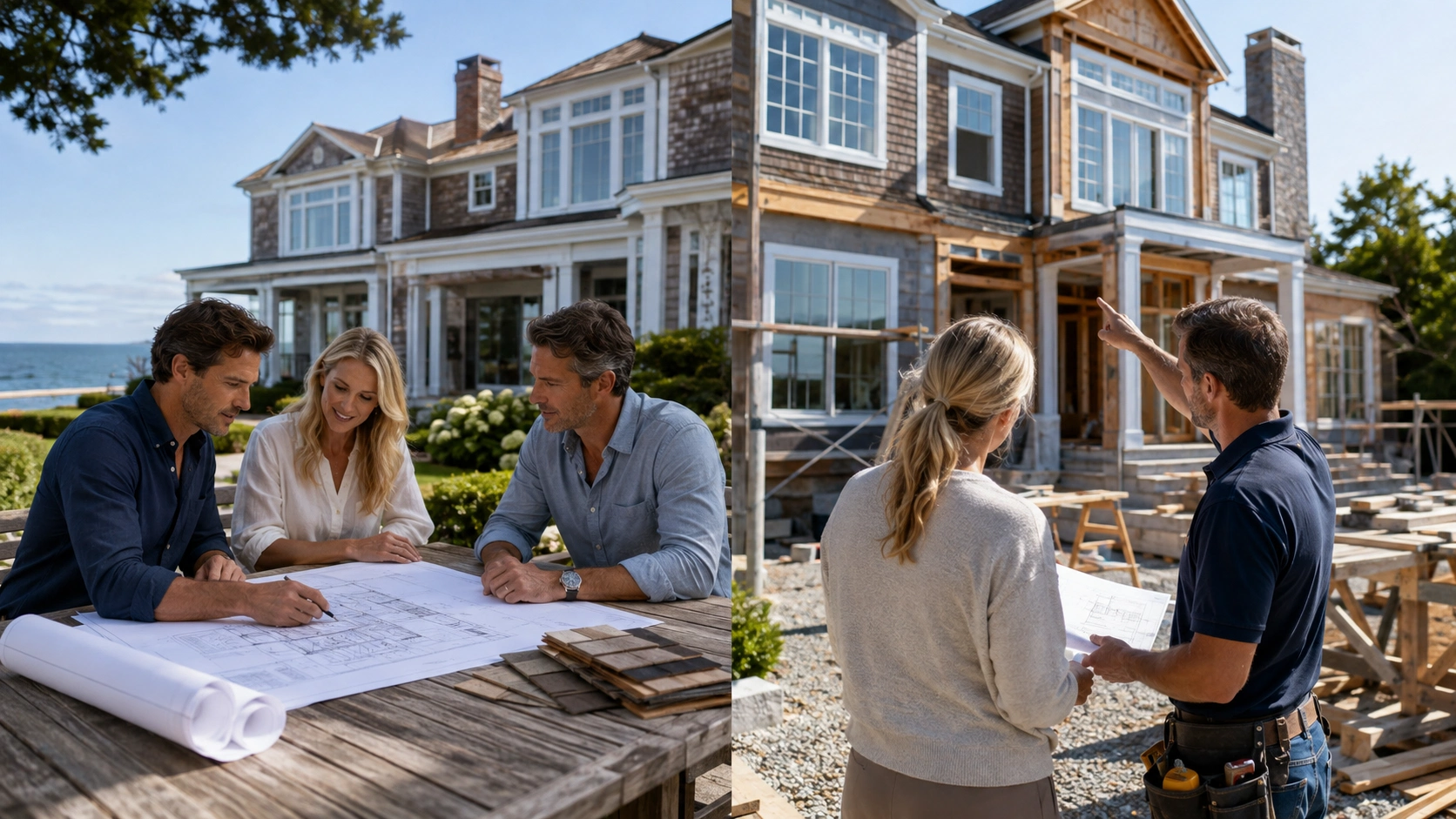
Design-build and general contractor are two different ways to structure who’s responsible for a Hamptons home project, and the difference shows up long before construction starts. Design-build puts one team in charge of both the design and the build under a single contract, while a general contractor builds from drawings a separate architect already produced.
Which one fits depends mainly on how far along the design already is and how much coordination you want to manage yourself. This guide breaks down what each model actually involves, what the research says about cost and timeline, and how the two handle Hamptons-specific permitting.
Key Takeaways
- Design-build combines design and construction under one contract; a general contractor builds from drawings someone else already produced.
- Design-build projects tend to finish faster and cost modestly less than traditional design-bid-build projects, according to research from the Construction Industry Institute and Penn State.
- A completed, permit-ready design is the clearest signal that a general contractor is the more direct path.
- Design-build shifts planning and cost estimating earlier, which is what makes a firmer price possible before construction starts.
- A general contractor project leaves the homeowner, or their architect, as the coordinator if design and construction interests don’t align.
- Local permitting relationships matter more in the Hamptons than in most markets, since each village runs its own building department and, often, an Architectural Review Board.
What Each Model Actually Involves
A general contractor is hired to build from a design that’s already complete. Someone else, typically an architect working independently, produces the drawings first, and the contractor bids on and executes that finished design under a separate contract from the homeowner.
Design-build collapses that sequence into one contract and one team. The same firm develops the design and builds it, which means pricing and constructability get factored in while the design is still being refined rather than after it’s locked.
The table below breaks down how the two models compare on the factors that matter most when choosing between them. For the fuller picture of how a design-build engagement is typically structured, see the complete guide to design-build in the Hamptons.
| Factor | Design-Build | General Contractor |
| Contract Structure | One contract covering design and construction | Separate contracts for the architect and the contractor |
| Cost Certainty | Pricing develops alongside design, more predictable | Bid happens after design is complete; cost can shift |
| Accountability | Single team responsible for the whole outcome | Owner coordinates between two separate parties |
| Best Fit | Projects where design and construction decisions are intertwined | Projects with completed drawings already ready to build |
What the Research Says About Cost and Timeline
Independent research comparing project delivery methods gives some sense of what to expect. A widely cited study from the Construction Industry Institute and Penn State found design-build projects were delivered noticeably faster, and modestly cheaper, than comparable projects run under the traditional design-bid-build sequence, where design and construction are handled by separate contracts.
That research compares design-build to design-bid-build specifically, not to a general contractor working from an already-completed design, which is a narrower comparison. When drawings already exist, the timeline and cost advantage of design-build shrinks substantially, since the phase where design-build creates the most value, integrating design and pricing together, has already passed.
Project complexity also affects how much the advantage shows up. A straightforward addition with a well-understood scope tends to see a smaller gap between the two models than a whole-home project involving structural changes, custom systems, and multiple trades working in sequence, where the coordination design-build provides has more opportunities to prevent delays.
When a General Contractor Is the Better Fit
A general contractor tends to be the more direct path when a complete, permit-ready design already exists, especially one produced by an architect the homeowner already trusts. There’s little for a design-build team to add at that point beyond execution, which is exactly what a general contractor is built to do.
A general contractor can also make sense for homeowners who want to stay closely involved in coordinating their own design and construction teams, or who specifically want the price tension that comes from bidding a finished design to multiple contractors.
This path works best when the homeowner or their architect is prepared to stay engaged through construction, since resolving a design question that comes up mid-build means looping the original architect back in rather than relying on a team that was already involved in every decision.
When Design-Build Is the Better Fit
Design-build tends to add the most value when design and construction decisions are still genuinely intertwined: structural changes that affect cost, material choices that affect timeline, layout decisions that affect permitting. Projects like this benefit from having the construction team in the room while those decisions are still being made.
Design-build is also the better fit for homeowners who want a single point of accountability rather than two separate contracts to manage. That same question, one team versus two, comes up again when comparing design-build against the traditional design-bid-build sequence, a related but distinct decision worth understanding on its own.
How Each Model Handles Hamptons Permitting and ARB Review
Hamptons villages each run their own building department, and several, including East Hampton Village and Southampton Village, layer an Architectural Review Board on top of standard permitting for exterior changes. How a project handles that review process differs meaningfully between the two models.
In design-build, the same team that designed the project also manages permitting, since local permitting relationships and a track record with a specific village’s building department are already part of the process. In a general contractor arrangement, the contractor may be encountering that specific board or department for the first time on this project, which can mean more back-and-forth if a design element doesn’t pass review as expected.
A design revision requested by an Architectural Review Board illustrates the difference well. Under design-build, the same team that drew the plans can typically adjust and resubmit without a separate coordination step. Under a general contractor arrangement, that revision usually has to route back through the original architect first, adding a round trip to the schedule.
This is one of the reasons an integrated design-build engagement tends to move more predictably through Hamptons permitting specifically, even though both models can ultimately get a project approved.
Things to Know
- General contractors typically charge a percentage markup on subcontractor and material costs, while design-build firms usually price the full scope as part of one negotiated contract.
- A general contractor project can go out to competitive bid among multiple contractors; a design-build contract is typically negotiated directly with one firm.
- New York requires contractors to carry specific licensing and insurance, and Suffolk County adds its own home improvement contractor licensing requirement on top of that.
- Change orders in a general contractor project usually require a formal written amendment; in design-build, the same team can often absorb smaller adjustments without a separate change order process.
- A design-build firm’s in-house architect or designer typically produces both concept drawings and construction documents, while a homeowner using a general contractor needs to secure both from an independent design source first.
- Warranty coverage can be simpler under design-build, since one party is responsible for both design and construction defects, rather than two parties who may dispute whose scope caused an issue.
Frequently Asked Questions
What’s the main difference between design-build and a general contractor?
Design-build combines design and construction under a single contract with one accountable team, while a general contractor builds from drawings someone else already produced.
That structural difference is what drives most of the practical differences in cost predictability, timeline, and who resolves problems when they come up.
Is design-build more expensive than hiring a general contractor?
Not necessarily, since design-build shifts planning and cost estimating earlier, which tends to reduce the change orders that often drive up a general contractor project’s final cost.
Research comparing delivery methods has found design-build projects finishing meaningfully faster and modestly under design-bid-build costs on average, though results vary by project.
Can I use a general contractor if I already have architectural plans?
Yes, and it’s often the more direct path once a completed, permit-ready design already exists.
A general contractor can price and build from those drawings without the added coordination design-build is built to solve. Design-build adds the most value earlier, before a design is finalized.
Does design-build save time compared to a general contractor?
Often yes, mainly because the design and bidding phases run in parallel rather than in sequence.
A general contractor project typically can’t start pricing until drawings are complete, while a design-build team prices as the design develops, which removes a full phase from the front end of the schedule.
Who handles permitting in a design-build vs general contractor project?
In design-build, the same team that designed the project also manages permitting, drawing on its existing relationship with that village’s building department.
In a general contractor arrangement, permitting responsibility typically depends on the contract, and the homeowner or architect may need to stay involved if the contractor didn’t produce the original drawings.
Choosing the Right Delivery Model for Your Project
The choice between design-build and a general contractor comes down to how far along your design already is and how much coordination you want to take on yourself, not which model is universally better.
Hamptons Luxury Design + Construction works as a fully integrated design-build firm across Southampton, East Hampton, Sag Harbor, Water Mill, and the surrounding villages, managing design and construction under one team and one contract. A site evaluation and initial conversation is the most reliable way to see how that structure would apply to your specific project.