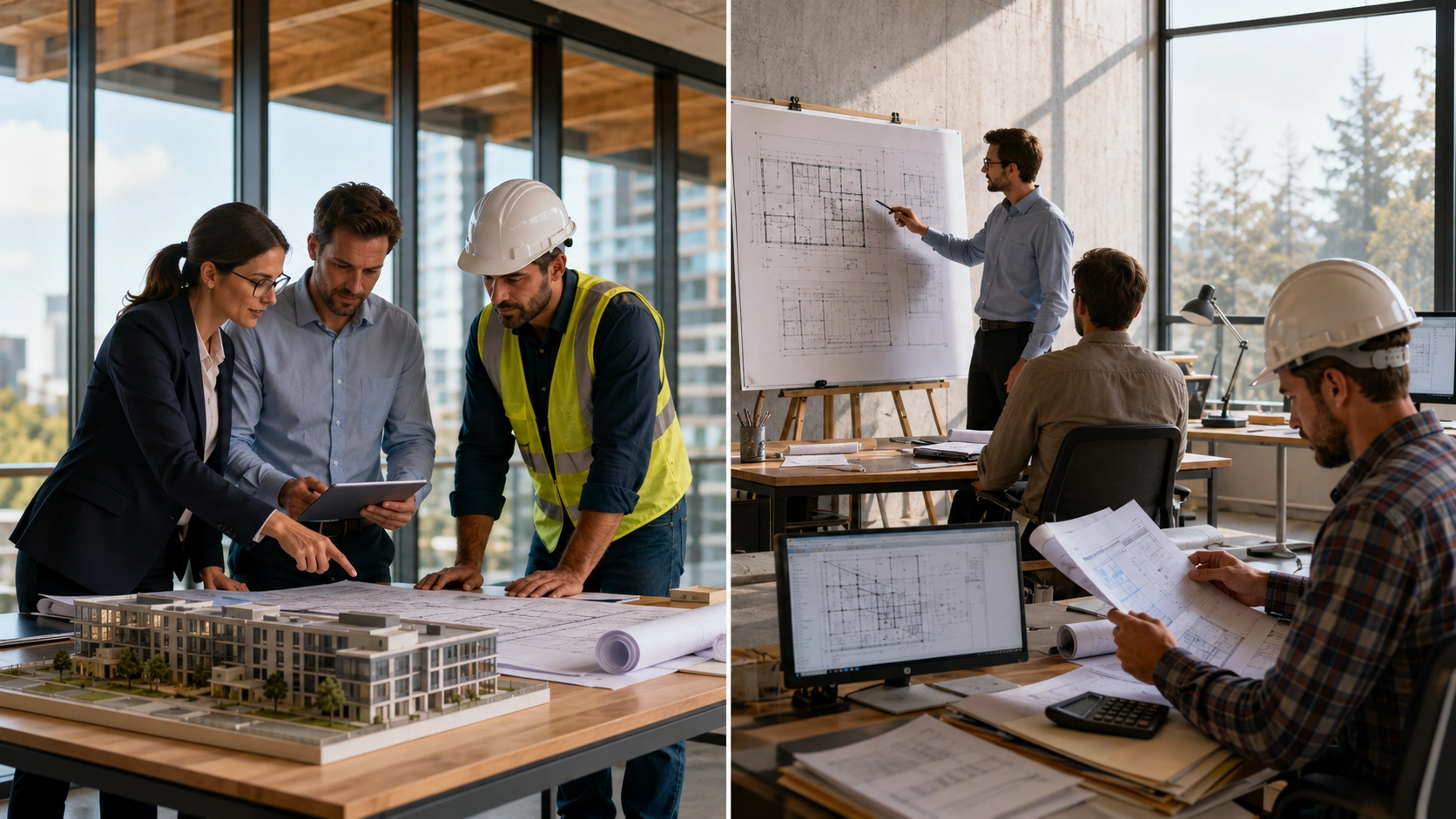
Design-bid-build runs a project through three separate phases, design, bidding, and construction, each under its own contract. Design-build compresses that into a single contract with one team, overlapping design and construction rather than running them in sequence.
That structural difference is what shapes everything else: who absorbs risk when something doesn’t go as planned, how change orders get handled, and how early real pricing enters the project. This guide breaks down how each process actually runs and when each one still makes sense.
Key Takeaways
- Design-bid-build is a three-phase sequential process using separate contracts; design-build compresses this into one contract with overlapping design and construction.
- Design-build now accounts for a large and growing share of U.S. construction spending, according to Design-Build Institute of America data.
- In design-bid-build, the owner absorbs most of the risk when a completed design turns out to be difficult or expensive to build.
- Change orders in design-bid-build typically require a formal RFI and pricing process, and work can stall while the crew waits for a signed amendment.
- Design-bid-build still delivers the most competitive initial pricing, since multiple contractors bid against each other on identical, completed drawings.
- The tradeoff is straightforward: design-bid-build optimizes for competitive pricing and clean role separation, while design-build optimizes for coordination and cost certainty.
How Each Process Actually Runs
Design-bid-build moves through three distinct stages. An architect designs the project first, the completed drawings go out to bid among general contractors, and construction begins once a contractor is selected and a second contract is signed.
Each stage in design-bid-build waits for the one before it to finish. Bidding can’t start until drawings are complete, and construction can’t start until a contractor is under contract, which is part of why the overall timeline tends to run longer than an equivalent design-build project.
Design-build compresses those stages. The design and construction team, part of planning a design-build project from day one, work under a single contract, with construction pricing developing as the design takes shape rather than waiting for it to finish. The table below lines up the two models side by side.
| Factor | Design-Bid-Build | Design-Build |
| Process Structure | Design, then bid, then build, in sequence | Design and construction overlap under one team |
| Pricing | Competitive bids on completed drawings | Cost develops alongside the design |
| Risk Owner | Owner absorbs risk of an unbuildable or costly design | Design-build team shares risk since they created the design |
| Change Handling | Formal RFI and change order process; can stall work | Internal adjustment; typically faster |
Where the Risk Sits in Each Model
In design-bid-build, the owner carries most of the risk tied to the design itself. If the completed drawings turn out to be expensive or difficult to build, that gap surfaces only after bids come in, and the owner absorbs the cost of redesign, value engineering, or a higher-than-expected price.
In design-build, that risk is shared. Because the same team produced the design and is responsible for building it, a buildability problem is one the team has an incentive to catch and resolve before it becomes an expensive surprise mid-construction.
A steel beam spec’d at a size the local supplier can’t deliver within the project timeline is a typical example. In design-bid-build, that gap surfaces only once the contractor starts ordering materials, well after the design is locked and bid. In design-build, the same conversation happens during design, when swapping the spec costs nothing but a phone call.
What Happens When Something Needs to Change
Design-bid-build handles changes formally. An unexpected site condition or a design element that doesn’t work as drawn requires a request for information, a priced change order from the contractor, and the owner’s signature before work can continue, sometimes with the crew waiting in the meantime.
Design-build tends to resolve the same issue internally, since the design and construction sides are part of the same team. Many design-build firms also run a buildability check during design specifically to catch these issues before they ever reach the construction phase.
Why Design-Build Has Been Gaining Ground
Design-build now accounts for a substantial and growing share of construction spending nationally, according to Design-Build Institute of America figures, reflecting a broader shift away from the strictly sequential model. The main driver is coordination: fewer silos between designer and builder tends to mean fewer surprises and fewer disputes over whose scope covers a given problem.
The silo effect in design-bid-build is a familiar pattern to anyone who has managed a renovation: when a delay happens, the builder points to the drawings as unbuildable, and the architect points to the builder for misreading the plans. Design-build doesn’t eliminate every disagreement, but it removes the incentive for either side to protect a separate scope of work at the other’s expense.
That shift shows up clearly once a project moves beyond finishes into structural or layout changes, where a design-build contract keeps the same team accountable for both the drawing and the outcome.
When Design-Bid-Build Is Still the Right Call
Design-bid-build still makes sense for owners who specifically want multiple contractors bidding against each other on an identical, finished design, since that competitive pressure genuinely can produce a lower initial price.
It also suits projects where a clean separation between designer and builder is a priority in its own right, either for accountability reasons or because an owner already has a trusted, independent architect they want representing their interests exclusively through the process.
Publicly funded projects and some grant-funded historic preservation work also default to design-bid-build, since competitive bidding requirements are often built into the funding itself. That’s less common on private luxury residential projects, but worth checking if a Hamptons property involves any preservation-related funding or easement.
Things to Know
- Design-build now accounts for a substantial share of construction spending nationally, per Design-Build Institute of America figures, reflecting a broader shift away from the sequential model.
- In design-bid-build, unexpected site conditions found during construction, like rock or utility lines, typically require a formal RFI and priced change order before work can continue.
- Design-bid-build separates roles cleanly, which some owners and architects prefer specifically because it keeps accountability distinct rather than shared.
- A competitively bid design-bid-build project isn’t necessarily cheaper in the end once change orders from redesign and rework are factored in.
- Design-bid-build can make sense for owners who specifically want multiple contractors bidding against each other on an identical, finished design.
- Constructability issues, elements of a design that are difficult, risky, or expensive to actually build, are more likely to surface late in a design-bid-build project, after the design is already finished.
Frequently Asked Questions
What’s the basic difference between design-build and design-bid-build?
Design-bid-build runs design, bidding, and construction as three separate phases under separate contracts, while design-build combines design and construction under one contract with overlapping phases.
That structural difference is what drives most of the practical differences between the two: who bears risk, how changes get handled, and how early real pricing enters the project.
Which delivery method is cheaper, design-build or design-bid-build?
Design-bid-build often produces a lower initial bid, since contractors compete against each other on identical drawings, but design-build tends to produce fewer costly change orders.
Whether one ends up cheaper overall depends heavily on how many surprises the project encounters after the initial bid, since those get resolved through separate, priced change orders in design-bid-build.
Why do change orders happen more often in design-bid-build?
Because the contractor doesn’t see the design until it’s finished, any buildability issue or design gap discovered during construction requires a formal RFI and a priced change order before work can continue.
In design-build, the same team that created the design can typically resolve these issues internally without a separate contract amendment, which is usually faster.
Is design-build replacing design-bid-build as the industry standard?
It’s gaining significant ground: Design-Build Institute of America data shows design-build now accounts for a large and growing share of U.S. construction spending.
Design-bid-build remains common, particularly on publicly bid projects and for owners who specifically want the role separation and competitive pricing it provides.
Can I still get competitive bids with design-build?
Not in the traditional sense of multiple contractors bidding the same finished design, since design-build is typically a negotiated contract with one firm.
Some owners address this by having a design-build firm develop the concept, then benchmarking that firm’s pricing against a rough estimate from a second source before committing.
Matching the Delivery Method to Your Priorities
Neither delivery method is universally better. Design-bid-build offers competitive pricing and clean role separation; design-build offers coordination and cost certainty. The right one depends on which of those tradeoffs matters more for your specific project.
Hamptons Luxury Design + Construction works as a fully integrated design-build firm across Southampton, East Hampton, Sag Harbor, Water Mill, and the surrounding villages, with design and construction accountable to the same team from the first sketch. A site evaluation and initial conversation is the most reliable way to see how that structure would apply to your project.