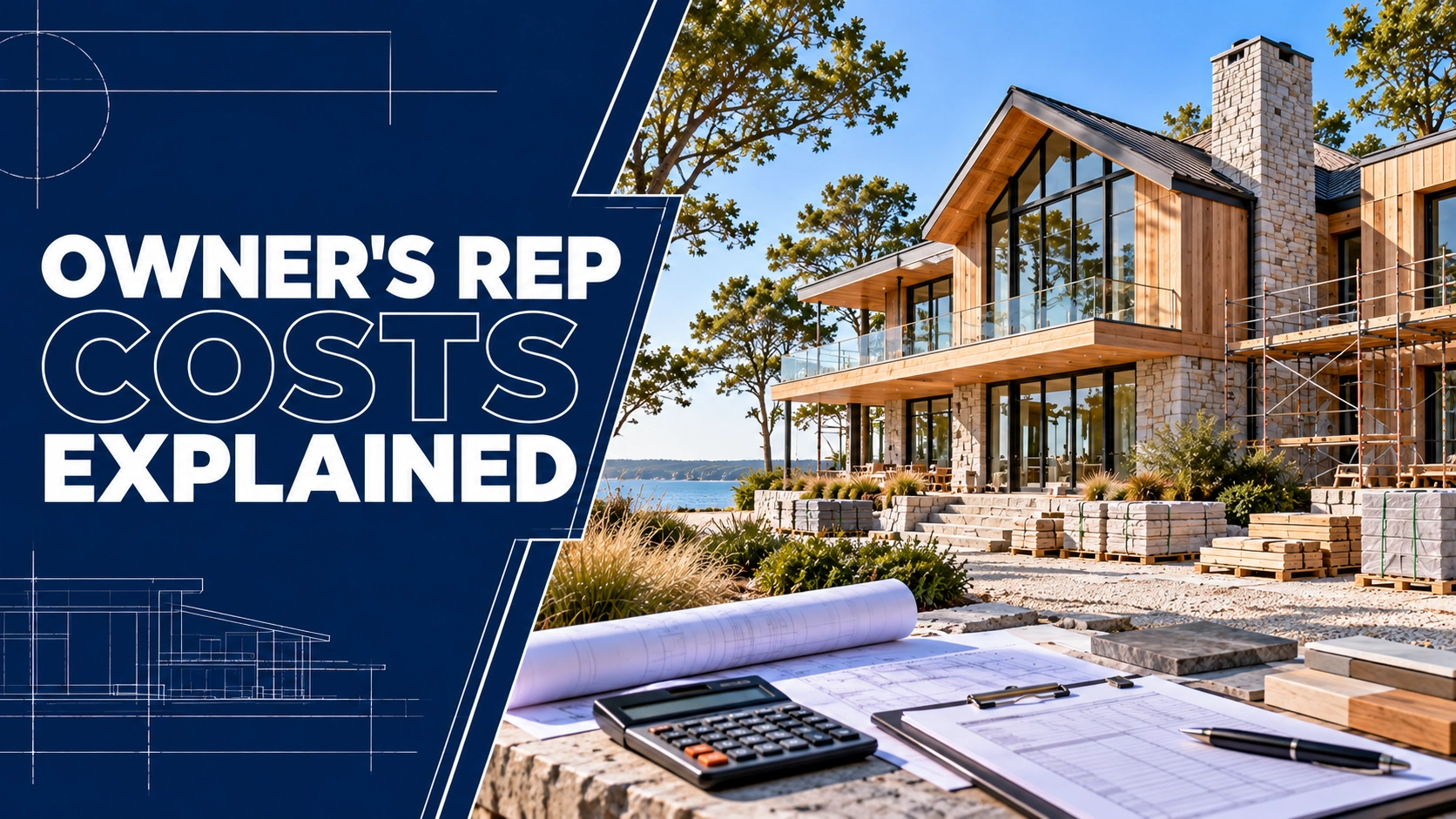

A residential owner’s representative is an independent advisor, hired and paid by the homeowner alone, who monitors the builder, the budget, and the schedule on the owner’s behalf. Independent oversight adds the most value on ground-up custom homes, older-home renovations, review-heavy waterfront lots, and troubled projects, where one missed problem is expensive and the owner can’t see everything firsthand.
This article looks at those situations one at a time, the points in a project where oversight pays back fastest, and the cases where it adds little.
Key Takeaways
- A residential owner’s representative works for the homeowner only, with no contract or financial tie to the builder.
- Value concentrates in six project profiles, from ground-up custom homes to projects already in trouble.
- Oversight pays back fastest before contract signing, at the first payment applications, and at each change order.
- Older homes carry the most scope uncertainty, since concealed conditions often surface only after demolition.
- Waterfront and review-heavy lots add approval steps that a missed sequence can turn into a lost season.
- Small, fixed-scope jobs gain the least, especially when the owner has the time and experience to stay involved.
Why the Residential Setting Changes the Job
A residential owner’s representative guides a homeowner through design, pricing, construction, and closeout. An institutional owner usually has a facilities department to review pricing, check pay requests, and track submittals. A homeowner usually doesn’t, and the representative fills that gap.
Independence is what makes the arrangement work. The representative is paid by the owner alone and holds no contract with the builder, so advice on cost, quality, and delays isn’t shaped by who gets paid. That is the model behind Hamptons Luxury Design + Construction’s owner’s representation team.
Residential work also adds a personal layer, since decisions carry taste, family schedules, and real money. The range of tasks, from budget tracking to documentation, falls under independent project monitoring across the whole build, and this article focuses on where that effort earns the most.
Where Independent Oversight Adds the Most Value
Value isn’t spread evenly across projects. Three factors raise it: the size of the financial exposure, the number of parties involved, and how much is still unknown at the start. A project that scores high on all three gets the most from a representative.
| Project profile | Main exposure | What the representative adds |
| Ground-up custom home | Pricing gaps, low allowances, and schedule slippage across many trades | Contract and bid review, payment checks, schedule tracking |
| Older-home renovation | Hidden conditions and scope that shifts after demolition | Scope reconciliation, change-order review, cost tracking |
| Waterfront or review-heavy lot | Approval sequence, flood and wetland rules, design review timing | Permit tracking, consultant coordination, early risk flags |
| Multi-structure property | Several teams, overlapping trades, uneven quality | One reporting line, a single schedule, consistent standards |
| Remote or seasonal owner | Slow decisions and problems found late | Dated reports, decision lists, site documentation |
| Troubled project | Disputes, missed milestones, unclear costs | Records audit, reset schedule, structured communication |
Most real projects fit more than one row. A waterfront ground-up build for an owner who lives in the city overlaps three of them, and each overlap raises the case for outside oversight.
Ground-Up Custom Homes on Land You Already Own
A new build on owned land carries the widest set of unknowns, because design, engineering, pricing, and permitting all happen before the foundation is poured. The strongest value arrives early, when a representative reviews the construction contract, compares bids line by line, and flags allowances set too low to be realistic. A fully custom home often runs 12 to 18 months or longer, and ground-up custom construction involves many trades and long payment schedules.
Once building starts, the work becomes disciplined tracking. That means checking each payment application against percent complete, confirming lien waivers, and watching custom orders such as windows, stone, and mechanical equipment, which can take many months from order to delivery. On a property with a main house, guest house, and pool, the same discipline keeps separate trade teams working to one schedule and one standard.
Older Homes, Additions, and Major Renovations
Renovation is where scope moves the most. An older Hamptons home can hide rot, outdated wiring, or unpermitted past work behind finished walls, and none of it shows until demolition begins. A representative separates what was priced from what was newly discovered, so each change order is reviewed against the original scope rather than approved under schedule pressure.
On major renovation work, the representative also checks that sequencing protects finished areas and that each repair is documented before it is closed up. Photos taken before walls close are cheap to collect and hard to recreate. Regular site-visit monitoring covers those pre-closure checks, which is why the timing of visits matters as much as their number.
Waterfront, Wetland, and Review-Heavy Lots
Coastal exposure, high water tables, flood zones, and wetlands add steps that sit outside the builder’s control. Villages and towns on the East End run their own approval processes, historic areas add Architectural Review Board review, and new septic work in Suffolk County generally calls for nitrogen-reducing systems. Requirements differ by location, so confirm current rules with the village or town.
A representative keeps those approvals in sequence. When the design team, surveyor, engineer, and builder each hold one piece, someone has to track which approval gates which task. Because some villages limit summer construction, a few weeks lost to a late permit can push exterior work into the following year.
The Moments Where Oversight Pays Back Fastest
Even on the right project, value clusters around a handful of decision points:
- Before contract signing: review of scope, allowances, payment terms, and schedule, when changes cost nothing.
- First payment applications: confirming the schedule of values matches the work in place, since early overbilling is hard to unwind.
- Each change order: pricing, schedule impact, and written approval before the work proceeds.
- Long-lead selections: matching order dates and approvals to the construction schedule.
- Closeout: punch list, final lien waivers, warranty documents, and as-built records.
Because these moments are concentrated, many owners scope an engagement by phase, with heavier involvement before and early in construction and lighter involvement once the project settles into a steady rhythm.
Stepping In When a Project Is Already in Trouble
A representative can also join midstream when a project has slipped, costs have become unclear, or the relationship with the builder has soured. The first step is a records audit covering the contract, approved changes, payments made against work in place, and open orders.
Next comes a realistic schedule and a single list of open decisions, which moves the conversation from blame to the next ten tasks. Rescue engagements usually recover less than early ones, because money already paid and choices already made are harder to unwind.
When Independent Oversight Adds Less
Not every project needs one. Small, fixed-scope jobs, such as updating a single bathroom or refinishing floors, usually cost less to oversee yourself than to hire for, and redecorating rarely justifies the fee. An owner with construction experience, regular time on site, and a clear fixed-price contract may need only occasional review. The hiring threshold is a separate question with its own checklist.
Fees matter too. Industry reporting describes engagements billed hourly or by monthly retainer, and some owners view percentage-of-cost billing with caution because it can tie compensation to a larger budget. Weighing paying for oversight against your exposure keeps the decision grounded in the project in front of you.
Things to Know
- Ask for the representative’s independence in writing: no builder contract and no referral fees.
- Engage before the construction contract is signed, when scope and payment terms can change at no cost.
- Scope the engagement by phase, since oversight is usually heaviest before and early in construction.
- Photos and records taken before walls close are hard to recreate later.
- Septic, flood, wetland, and design review rules vary by village and town, so confirm with the local board.
- Custom orders for windows, stone, and mechanical equipment can run many months, so confirm order dates early.
Frequently Asked Questions
What does a residential owner’s representative do that my builder doesn’t?
A residential owner’s representative works only for you, checking the builder’s pricing, payment requests, and progress without any stake in the builder’s profit.
A builder’s job is to deliver the project, while the representative’s job is to verify that it is delivered as contracted and priced. Because the representative holds no contract with the builder, your questions about cost, quality, and delays get an independent answer.
Is a residential owner’s representative worth it for a renovation?
Usually yes for large or older-home renovations, and less often for small, fixed-scope jobs.
Older Hamptons homes can hide rot, outdated wiring, or unpermitted past work, and each discovery becomes a change order someone has to price and approve. On a single-room update with a clear scope, the fee often buys little that careful self-review would not.
When should I bring in a residential owner’s representative?
Before the construction contract is signed, while scope, allowances, and payment terms can still change at no cost.
Early involvement lets the representative review the contract, compare bids, and check the schedule before commitments are made. Joining midstream still helps, but money already paid and decisions already made are harder to unwind.
Can a residential owner’s representative help if my project is already behind or over budget?
Yes, though recovery is usually easier the earlier they join.
The first step is typically an audit of the contract, approved changes, payments made, and open orders. From there, the representative can rebuild a realistic schedule and a single list of open decisions, which gives you and the builder a shared starting point.
Does a residential owner’s representative replace my designer or builder?
No, the representative monitors and coordinates the team but does not design the home or perform the construction.
Your designer still shapes the plans and finishes, and your builder still manages the trades and the work on site. The representative sits on your side of the table, tracking cost, schedule, quality, and paperwork across all of them.
Choosing Where Extra Oversight Earns Its Place
A residential owner’s representative adds the most where exposure is high, the team is large, or the unknowns are many. That usually means new construction on owned land, older homes, and waterfront lots, and it matters less on small projects with clear scope.
Hamptons Luxury Design + Construction works with owners in Southampton, East Hampton, Sag Harbor, Water Mill, and the surrounding villages. A conversation about your site and schedule is the quickest way to see how much oversight your project actually calls for.