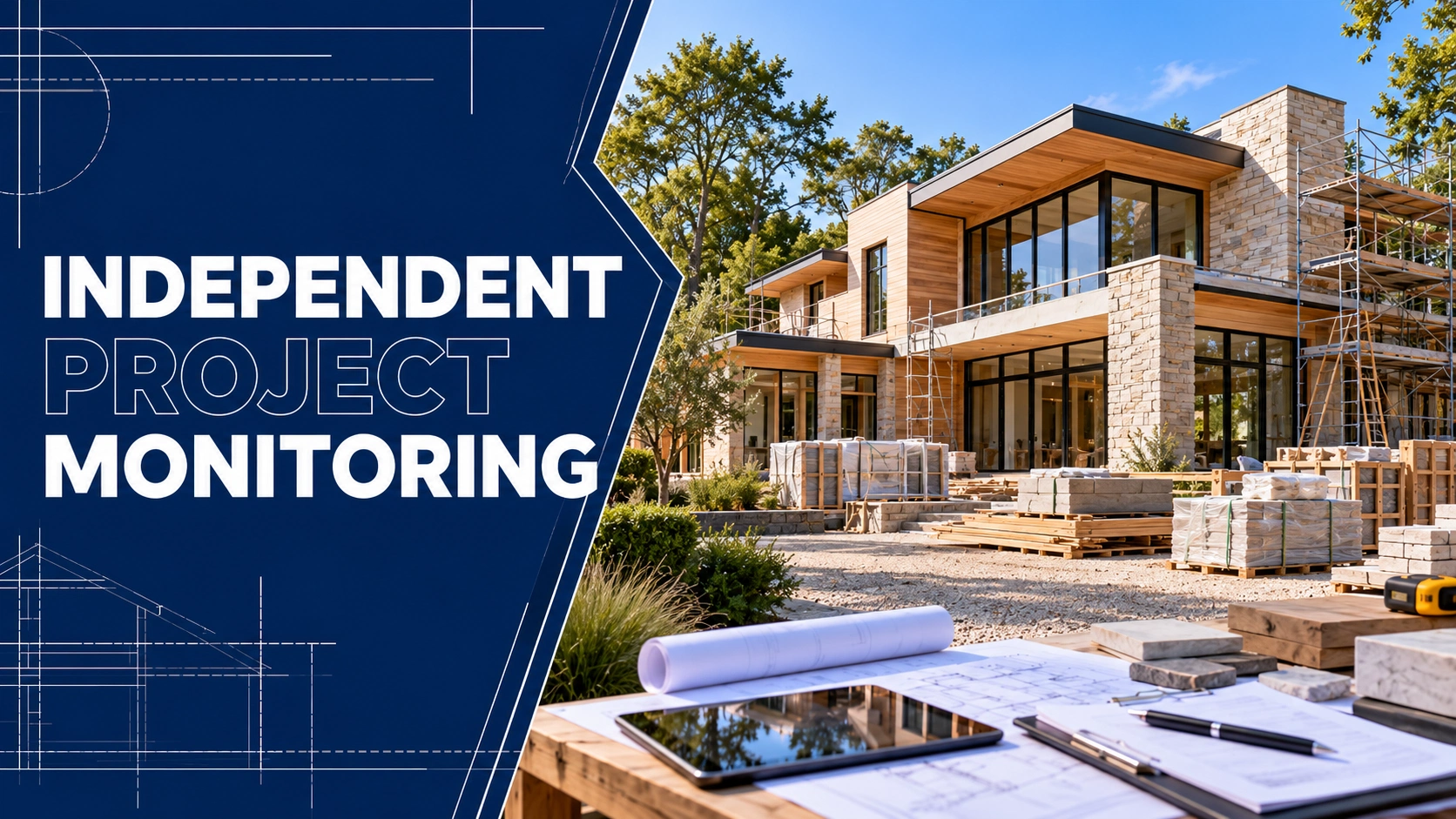
Construction oversight services give a homeowner independent eyes on a build, tracking budget, schedule, quality, paperwork, and decisions so problems surface early and the owner stays in control of the outcome.
Key Takeaways
- Oversight is owner-side monitoring; it checks the builder’s work and does not replace it.
- Eight control areas cover the whole project: budget, schedule, quality, documentation, meetings, decisions, contractor accountability, and communication.
- The earlier oversight begins, the more it can influence scope, contract terms, and cost.
- Work that gets covered up, like footings and in-wall systems, should be observed before it disappears.
- Written reports, photos, and a decision log turn progress into something an owner can verify.
- Hamptons projects add coastal exposure, varied village and town rules, and owners who are not on site every day.
What Construction Oversight Services Cover
Construction oversight services are the checks an owner puts in place to confirm that a project is delivering what was promised, at the price and pace agreed. They sit on the owner’s side of the table. The builder builds, the design team designs, and the person providing oversight verifies, reports, and advises.
In practice, oversight is a system rather than a single task. It gives the owner a steady flow of reliable information across eight control areas, so decisions are made on facts instead of assumptions. An owner’s representative services engagement is the most common way to deliver that system on a residential project, and the basics of the role are covered in owner’s rep in Bridgehampton.
Oversight also differs from construction management services, where the manager helps run the delivery of the work. Oversight does not direct trades or build anything; it watches the work and the paperwork, then tells the owner what it sees. The rest of this guide walks through the framework that makes that practical.
The Oversight Framework at a Glance
The table below summarizes the eight control areas, what each one monitors, and what the owner should expect to receive.
| Control Area | What Is Monitored | What the Owner Receives |
| Budget | Pay applications, change orders, allowances | Cost-to-date and forecast reports |
| Schedule | Progress against baseline, long-lead orders | Look-ahead updates and delay notices |
| Quality | Work against drawings and specifications | Site observation notes and photos |
| Documentation | Submittals, requests for information, logs | An organized project record |
| Meetings | Owner, builder, and design team coordination | Agendas, minutes, and action lists |
| Decisions | Selections, approvals, and deadlines | A decision log with due dates |
| Contractor accountability | Contract compliance, punch list, holdbacks | Written notices and tracked corrections |
| Owner communication | One channel and plain-language updates | Regular summaries and an escalation path |
Each area supports the others. A late decision affects the schedule, a schedule slip affects the budget, and weak documentation makes every dispute harder to resolve, which is why oversight works best as a connected set of habits.
Budget: Tracking Cost, Changes, and Payments
The budget is the first thing oversight protects. That starts with understanding what the contract price includes, which allowances are placeholders, and where the builder’s number depends on assumptions. Once work begins, the question shifts to whether the money going out matches the work in the ground.
A steady habit of reviewing payment applications against actual progress keeps each payment tied to completed work. Change orders deserve the same scrutiny: each one should state its cost, its effect on the schedule, and who approved it, in writing, before the work proceeds.
A running cost report ties it together. It shows the original contract, approved changes, payments to date, and the forecast to finish, so the owner sees any drift early, when it can still be corrected.
Schedule: Tracking Progress and Long-Lead Items
Schedule oversight begins with a baseline the owner can read. From there, regular look-ahead updates show what is coming over the next several weeks and what could hold it up. Custom windows, stone, millwork, and mechanical equipment are often ordered months ahead, so a late order can delay a milestone long before anyone sees it on site.
Hamptons projects add a few seasonal and local factors. Some villages limit construction activity in the summer season, permit and inspection timing varies by jurisdiction, and coastal weather can interrupt exterior work. Oversight keeps those factors visible so the owner is not surprised by a date that has quietly moved.
When a milestone does slip, the useful question is how to recover. A good schedule review looks at which activities can overlap, which trades can be resequenced, and whether the lost time affects move-in, seasonal use, or the next phase of financing. Seeing those options early gives the owner real choices, instead of a revised date that arrives with no explanation.
Quality: Verifying the Work in the Field
Quality oversight happens in person. The observer compares the work with the drawings, specifications, and accepted trade practice, and pays special attention to anything that will be covered later. The details of what to inspect, and when, are laid out in construction monitoring services.
On the East End, certain details deserve extra attention. Coastal exposure puts salt air, wind, and moisture to work on exterior assemblies, and high water tables make foundation waterproofing and drainage important. Flashing, window installation, and below-grade work are classic places where a problem is cheap to fix before it is hidden and expensive to fix after.
Observation is documented with dated notes and photos so that any issue becomes a tracked item with an owner and a due date, not a recollection.
Documentation, Meetings, and Decisions
A project with good records is easier to run and easier to defend. Oversight keeps the project record organized so the owner can find any approval, drawing revision, or conversation when needed. The core documents include:
- Dated site observation reports with photos.
- Submittals and requests for information, with answers and dates.
- A change order log with costs and approvals.
- A decision log listing each open choice and its deadline.
- Meeting agendas, minutes, and action items.
- Closeout records, including warranties, manuals, and as-built information.
Meetings follow the same discipline. A regular meeting with a written agenda and minutes keeps the owner, builder, and design team aligned, and the action list shows who owes what by when. The decision log matters most, since owner selections are a leading cause of delay, and a reminder before each deadline keeps choices from becoming bottlenecks.
Where the records live matters too. A shared digital folder with consistent file names lets the owner, builder, and design team work from the same current documents, and it means nothing is lost when a team member changes. Owners who split time between homes find this especially useful, since the whole record is available wherever they are.
Contractor Accountability and Owner Communication
Accountability means the contract is followed and gaps are addressed in writing. When work does not match the documents, oversight issues a clear notice, tracks the correction, and confirms it before payment moves on. Toward the end, it manages the punch list and the final holdback so that finishing touches get done and the owner is not left chasing them.
Communication is the thread that holds this together. A single channel between the owner and the project team prevents mixed messages, and a regular plain-language summary tells the owner what happened, what it means, and what needs attention. For owners who live elsewhere or are away for the season, that summary may be the main window into the project.
When a problem persists, the escalation path matters. A good process moves from a conversation, to a written notice, to a formal request that follows the contract’s own steps for correcting defective or late work. Having that path defined in advance keeps disagreements professional and keeps the project moving while they are resolved.
How Oversight Changes Across the Project Phases
The emphasis shifts as the project moves forward, but the same eight areas stay in play. Before construction, oversight focuses on scope, budget assumptions, contract terms, and the builder’s schedule, since that is when changes cost the least. During construction, it moves to field observation, payment review, change order control, and meeting follow-up.
At closeout, attention turns to the items that decide how the project ends:
- A complete punch list, with each item tracked to a verified correction.
- Final lien waivers and release of the final holdback.
- Delivery of warranties, manuals, permits, and as-built information.
- A final walkthrough that matches the work to the contract documents.
- A handoff of the project record to the owner.
Treating closeout as a phase of its own prevents a common problem, where a finished-looking house still has open items and no clear owner for resolving them.
Bringing in Oversight: Timing, Selection, and Cost
Many owners begin by asking about the need for independent oversight, and the answer usually depends on project size, complexity, and how much time the owner can give. Once the decision is made, choosing an owner’s representative comes down to experience, process, and how well their reporting fits the way you like to be informed.
Cost is the next question, and the cost of an owner’s representative depends on the project’s scope, duration, and level of involvement. The value tends to be clearest on projects where the stakes are high, which is the subject of residential owner’s representative support.
Whoever provides oversight, the same test applies. The person should answer only to the owner, be paid by the owner rather than the builder, and report problems plainly even when the news is unwelcome. That independence is what makes the reports trustworthy, and it matters most for owners who cannot be on site often.
Things to Know
- Bring in oversight before the contract is signed whenever possible.
- Ask for sample reports so you know what you will actually receive.
- Set a regular visit rhythm and add visits at critical milestones.
- Require written approval for every change before work proceeds.
- Keep one communication channel between you and the project team.
- Confirm how documents will be stored and who can access them.
Frequently Asked Questions
What are construction oversight services?
They are owner-side services that monitor a building project’s budget, schedule, quality, and paperwork so the owner decides with independent information.
The oversight professional does not build anything. Instead, they check the builder’s work and reports against the contract, flag problems early, and keep the owner informed so decisions are made before they become expensive.
How is construction oversight different from construction management?
Oversight works for the owner and monitors the builder, while a construction manager or general contractor runs and delivers the construction itself.
A construction manager coordinates trades and runs the day-to-day work. Oversight sits on the owner’s side of the table and checks that cost, schedule, and quality match what was agreed, which is why some owners use both on a large project.
When should a homeowner bring in construction oversight?
Ideally before the contract is signed, though oversight adds value at every stage through closeout.
Early involvement lets the oversight professional review scope, budget, and contract terms while they can still be changed. Owners who start mid-project can still benefit, particularly from payment review, site observation, and punch list tracking.
How often should oversight visit the construction site?
Frequency depends on the project’s size and stage, with more visits during critical phases such as foundations, framing, and rough-ins.
Work that will be covered up, like footings, waterproofing, and in-wall systems, deserves a look before it disappears. Many owners set a regular visit rhythm and add extra visits at defined milestones.
What does a homeowner receive from construction oversight?
Regular written reports, site photos, budget and change-order tracking, and a clear list of decisions waiting on the owner.
The goal is a project record that is easy to read without a construction background. Reports typically cover progress, cost, schedule, open issues, and upcoming deadlines, so the owner always knows where the project stands.
Putting Oversight to Work on Your Hamptons Project
Good oversight is a habit more than a title. It brings budget, schedule, quality, records, and decisions into one clear view so the owner can act with confidence from the first drawing to the final walkthrough.
Hamptons Luxury Design + Construction works with owners across Southampton, East Hampton, Sag Harbor, Water Mill, and the surrounding villages. A conversation about your project is a practical way to see which oversight checks make sense at each stage.