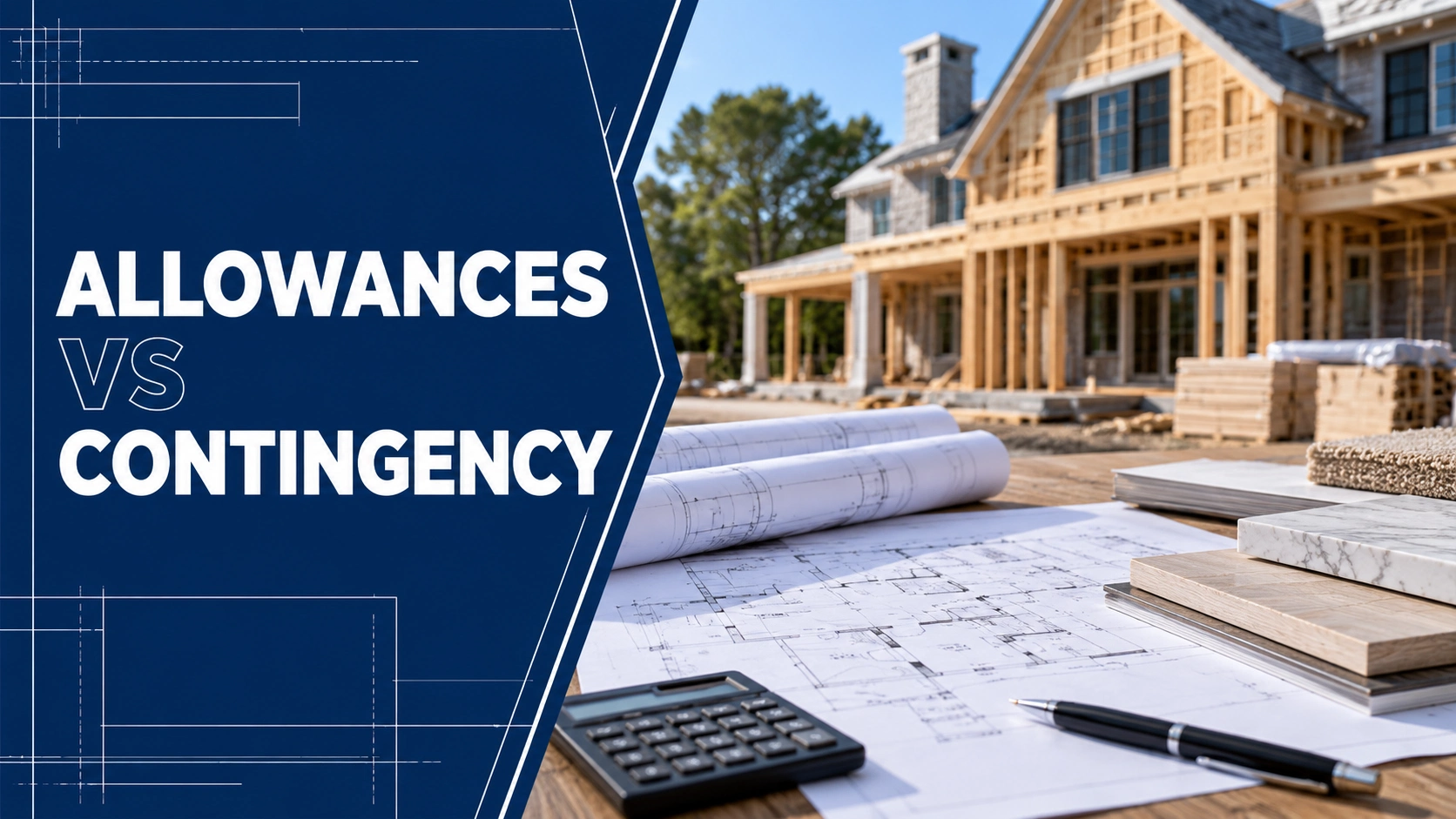
Allowances and contingency both set aside money in a construction budget, but for different reasons. An allowance covers a known item that hasn’t been fully selected yet, like light fixtures or tile; contingency covers an unknown risk that hasn’t been identified yet, like a hidden site condition.
This guide covers how each actually works, the different types of contingency, who controls it, and why thorough preconstruction planning reduces how much of both a project genuinely needs.
Key Takeaways
- An allowance covers a known item that hasn’t been fully selected yet, like light fixtures or tile, budgeted as a placeholder until the final choice is made.
- Contingency covers unknown risks, unforeseen site conditions, design changes, or market shifts, that haven’t been identified yet and may never happen.
- A simple way to remember the difference: allowances are for known unknowns, contingency is for unknown unknowns.
- If an allowance selection costs more than budgeted, the difference is typically billed as a change order; if it costs less, the owner may save the difference or reallocate it.
- Contingency itself isn’t a single category. Design contingency shrinks as the design develops, while construction contingency covers conditions discovered once building is underway.
- Thorough preconstruction planning, a completed design and a thorough site evaluation, reduces how much contingency a project actually needs, since fewer unknowns remain by the time construction starts.
Known Unknowns vs. Unknown Unknowns: The Core Difference
Allowances and contingency both set aside money in a construction budget, but for fundamentally different reasons, and confusing the two is one of the more common sources of budget surprises during early project planning and beyond.
The simplest way to remember the distinction: allowances are for known unknowns, items you know you need but haven’t selected yet. Contingency is for unknown unknowns, risks or conditions you haven’t identified and may never encounter.
The table below lays out how the two compare directly.
| Factor | Allowance | Contingency |
| What It Covers | A known item not yet fully selected | An unknown risk not yet identified |
| Example | Light fixtures, tile, plumbing fixtures | Hidden site conditions, design changes |
| Typical Outcome | Reconciled against actual selection cost via change order | Drawn down if the risk occurs, unused if it doesn’t |
| Who Manages It | Tracked per line item in the schedule of values | Held as a reserve, usually by the owner or CM |
How Allowances Work in Practice
An allowance is a specific dollar figure set aside in the budget for an item that’s expected but not yet fully selected, light fixtures, tile, plumbing fixtures, cabinet hardware. It gives the project a number to work with before every finish decision is finalized.
Once the actual selection is made, the allowance gets reconciled against its real cost. If the selection costs more than the allowance, the difference is typically billed as a change order. If it costs less, the owner may save the difference or choose to reallocate it elsewhere in the project.
A $10,000 lighting allowance illustrates this well. If the actual fixtures selected come to $14,000, the additional $4,000 gets documented and billed as a change order. If they come to $7,000 instead, the remaining $3,000 can typically be credited back or shifted to another line item, depending on how the contract structures it.
The Different Types of Contingency
Contingency isn’t a single, uniform category. Design contingency covers items still being defined during the design process and typically shrinks as drawings and specifications get finalized. Construction contingency covers conditions discovered once building is actually underway, an unexpected site condition, a design omission that surfaces mid-build.
Some projects also distinguish between an owner’s contingency and a contractor’s contingency, each held and controlled separately, covering different categories of risk. Understanding which type of contingency applies to a specific budget line matters more than treating contingency as one undifferentiated cushion.
On an older Hamptons property, construction contingency tends to matter more than design contingency, since older sites are more likely to reveal conditions, outdated wiring, unexpected soil composition, a foundation issue, that only become visible once demolition or excavation actually begins.
Who Controls Contingency, and How Much Is Enough
Contingency is typically held and released by the owner or the construction manager, not the contractor, since it exists to protect the owner’s interests specifically. A contingency reserve in the 10 to 20 percent range is common on older or more complex sites, directly connected to the building cost expectations set during early budgeting.
Contingency that goes unused by the end of a project isn’t wasted; it’s simply money that didn’t need to be spent, which is the outcome everyone should actually hope for. A project that draws down its full contingency reserve is one that encountered real, unplanned costs along the way.
Tracking contingency drawdowns against specific, documented causes, rather than treating the reserve as one undifferentiated pool, also makes it easier to see whether a project’s unforeseen costs are following a normal pattern or signaling a deeper problem with how the site or scope was originally assessed.
How Preconstruction Planning Reduces the Need for Both
The amount of contingency a project actually needs isn’t fixed; it shrinks as more of the unknowns get resolved before construction starts. A completed design, a thorough site evaluation, and a detailed Hamptons custom construction estimate all reduce how much cushion is genuinely necessary, since fewer decisions remain open once building begins.
Allowances follow a similar logic in reverse: the more finish selections that get locked in before the contract is signed, the fewer allowance line items remain as placeholders, and the more the budget reflects real, confirmed costs rather than estimates.
Things to Know
- An allowance without a specific dollar figure attached isn’t a real budget protection; it needs a number, not just a category name.
- Contingency held by the owner is different from a contractor’s own internal contingency, built into their pricing, which isn’t visible to the owner as a separate line item.
- Design contingency shrinks as drawings develop; construction contingency stays available until the project reaches substantial completion, since unforeseen conditions can surface throughout the build.
- A contingency reserve of 10 to 20 percent is common on older or complex Hamptons sites, with straightforward new-construction lots typically needing less.
- Unused contingency at the end of a project can typically be returned to the owner or credited against the final payment, depending on how the contract defines it.
- Confusing allowances and contingency in a budget conversation can lead to underfunding one or both, since they’re solving two genuinely different problems.
Frequently Asked Questions
What’s the simplest way to understand the difference between an allowance and contingency?
Allowances are for known unknowns, items you know you need but haven’t selected yet; contingency is for unknown unknowns, risks or conditions you haven’t identified and may never encounter.
That distinction is why both belong in a budget separately rather than combined into one general cushion, since they’re solving two different kinds of uncertainty.
What happens if my actual selection costs more than the allowance?
The difference between the allowance and the actual selection cost is typically billed as a change order, added to the contract price once the selection is finalized.
If the actual cost comes in under the allowance instead, the owner may save that difference or choose to reallocate it to another part of the project, depending on how the contract handles it.
How much contingency should I budget for a custom home?
A contingency reserve of 10 to 20 percent of the construction budget is common, with older or more complex sites typically landing toward the higher end of that range.
A straightforward new-construction lot with few unknowns can often work with a smaller reserve, while a renovation or a site with challenging conditions usually warrants more.
Who decides when contingency funds get used?
Contingency is typically controlled by the owner or the construction manager, not the contractor, and its use usually requires documented approval before funds are released.
This keeps contingency from being spent informally on convenience upgrades rather than the unforeseen conditions it’s actually meant to cover.
Does having a completed design reduce how much contingency I need?
Yes. A completed design and a thorough site evaluation resolve many of the unknowns contingency exists to cover, which means less reserve is genuinely necessary by the time construction starts.
This is one of the practical arguments for investing time in preconstruction planning: it doesn’t just produce a better design, it reduces the real financial risk the project is carrying.
Budgeting for the Known and the Unknown
Allowances and contingency solve two different problems in a construction budget, and treating them as interchangeable is one of the more avoidable sources of confusion on a custom home project.
Hamptons Luxury Design + Construction structures allowances and contingency clearly on every luxury home project across Southampton, East Hampton, Sag Harbor, Water Mill, and the surrounding villages, so owners understand exactly what each dollar in the budget is actually protecting. A conversation about your specific project is the best place to start.