
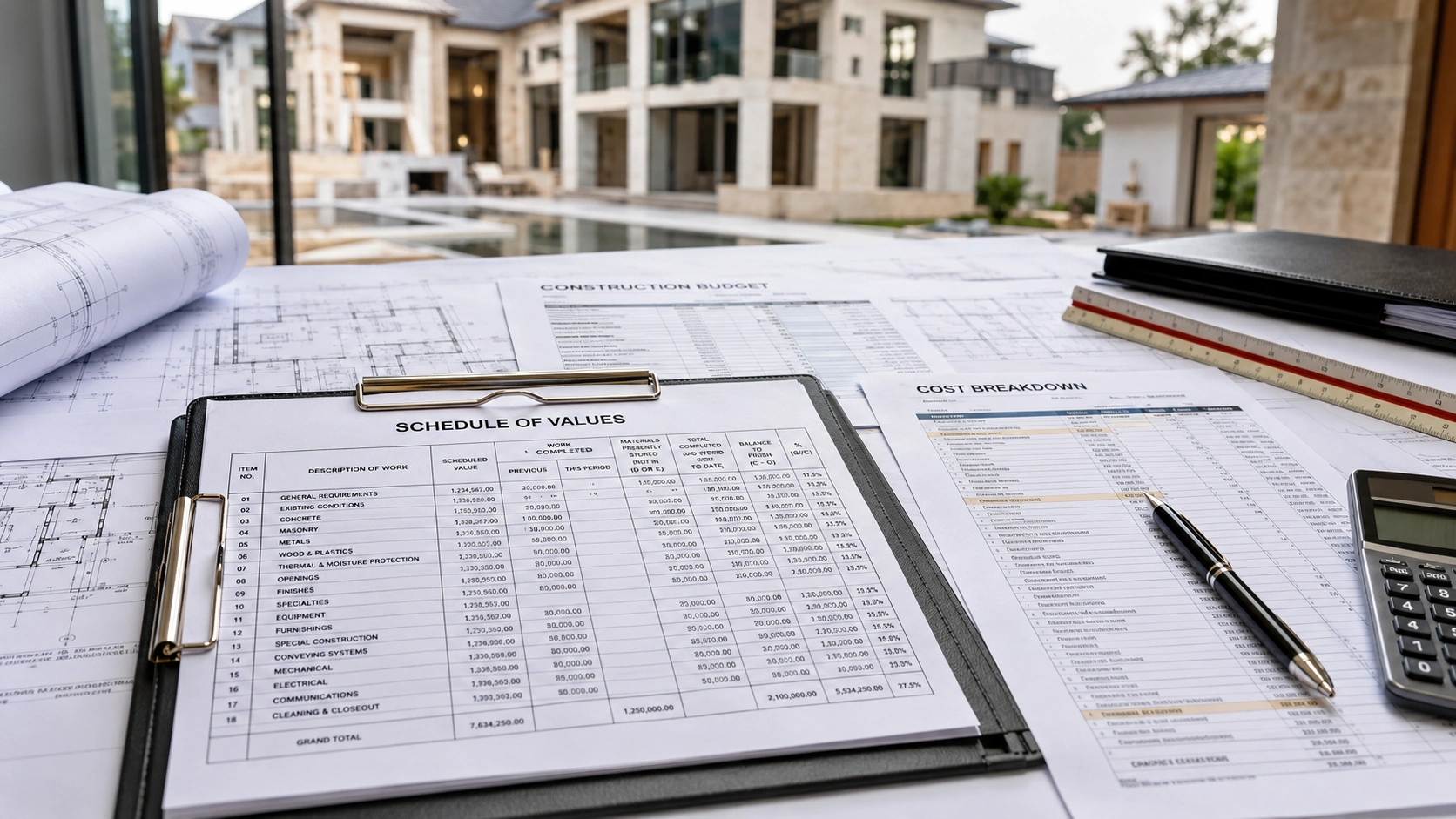
A schedule of values breaks a construction contract’s total price into individual line items, each with its own dollar value, so progress payments can be billed against the percentage of each item actually completed rather than the contract as a whole. It’s typically submitted in the AIA G703 format, tied to the G702 payment application form.
This guide covers what a schedule of values actually breaks down, how it gets built, what each line item tracks, and why getting it right the first time matters more than most owners expect.
Key Takeaways
- A schedule of values breaks the total contract sum into individual line items, each with its own dollar value, so progress payments can be billed against completed portions rather than the contract as a whole.
- The most common format is AIA Document G703, a continuation sheet typically submitted alongside the G702 payment application form.
- Each line item’s percentage of completion, not just whether it’s in progress, is what determines how much can be billed for that item in a given period.
- Retainage, a percentage withheld from each payment until the project reaches substantial completion, is tracked directly on the schedule of values.
- A schedule of values should be built from the same cost codes used in the original estimate, since reconstructing or oversimplifying it later makes reconciling actual costs against the budget difficult.
- The schedule of values total must match the contract sum exactly. A mismatch is one of the most common reasons a payment application gets sent back before it’s even reviewed.
What a Schedule of Values Actually Breaks Down
A schedule of values exists to turn a single contract price into something that can be billed incrementally. Instead of one lump sum, the total gets divided into line items, foundation, framing, electrical rough-in, millwork, and so on, each assigned its own portion of the overall price. That structure is what makes structured project oversight possible: a construction manager can track exactly which parts of the contract are ahead, on track, or behind at any point.
It’s easy to confuse the schedule of values with the payment application that bills against it, since the two are closely linked and usually submitted together. The table below separates what each document actually does.
| Document | Purpose | When It’s Created |
| Schedule of Values | Breaks the contract sum into priced line items | Established once before construction begins, revised only for approved changes |
| Payment Application | Requests payment based on the percentage complete for each line item | Submitted each billing cycle, typically monthly |
How a Schedule of Values Gets Built
The contractor typically prepares the schedule of values, and the architect or construction manager reviews and approves it before the first payment application is submitted. The most reliable version is built directly from the same cost codes used in the original estimate, so each billing line item maps back to how the project was actually priced.
Problems tend to start when a schedule of values is reconstructed or simplified separately from the estimate just to make billing easier. Once that happens, reconciling what’s actually been spent against what was budgeted becomes far harder, since the two documents no longer speak the same language.
Reading the Line Items: What Each Column Tracks
A standard schedule of values, following the AIA G703 format, tracks several figures for every line item across the life of the project:
- Scheduled value: the total contracted price for that line item.
- Previous applications: the amount already billed in prior periods.
- This period: the amount being billed in the current cycle.
- Materials stored: the value of materials delivered on-site but not yet installed.
- Total completed and stored to date: the sum of everything billed and stored so far.
- Percent complete: total to date divided by the scheduled value.
- Balance to finish: the scheduled value minus the total completed to date.
- Retainage: the percentage withheld from that line item until later in the project.
Every one of these figures accumulates from one billing cycle to the next, which is why a small error early in the project tends to compound rather than stay contained.
Retainage and Why It’s Tracked Here
Retainage is a percentage held back from each payment, commonly 5 to 10 percent, as security that the work will be completed to standard. Because it applies per line item, the schedule of values is where it actually gets calculated and tracked, not the payment application itself.
Most contracts step retainage down, or release it entirely, once the project reaches substantial completion, with any remaining balance paid out at final closeout. Getting this structured correctly from the start is one of the reasons dedicated construction management reviews the schedule of values closely before the first payment cycle even begins.
Common Mistakes That Delay a Payment Application
A schedule of values total that doesn’t match the contract sum exactly is the single most common reason a payment application gets sent back before it’s reviewed in detail, since every subsequent billing cycle is measured against that total.
Change orders that get absorbed informally into an existing line item, rather than added as their own line, are another frequent issue, since they make the document stop reflecting what was actually approved. Because monthly payment applications are built directly from the schedule of values, an error here doesn’t stay contained. It shows up in every billing cycle until it’s corrected.
Things to Know
- The schedule of values total must match the contract sum exactly; a mismatch is one of the most common reasons a payment application gets rejected before review.
- Retainage percentages are negotiated in the contract, commonly 5 to 10 percent, and are typically reduced or released as the project approaches substantial completion.
- A schedule of values built directly from the original estimate’s cost codes is far easier to reconcile later than one reconstructed or simplified just for billing purposes.
- Materials stored on-site but not yet installed can often be billed, but usually require proof of ownership or a delivery receipt before an architect or CM will certify that portion.
- Change orders need to be added to the schedule of values as new or revised line items, not absorbed into an existing line, or the document stops accurately reflecting the contract.
- On a luxury custom home, specialty trade packages, millwork, stone, smart home integration, are often broken into their own line items rather than lumped into general categories, since that level of detail is what protects the budget.
Frequently Asked Questions
What is a schedule of values used for?
A schedule of values breaks a construction contract’s total price into individual line items, so progress payments can be billed against the percentage of each item actually completed.
It’s the reference document that a payment application bills against each cycle, and without it there’s no agreed-upon way to verify how much of the contract has actually been earned at any point.
Who creates the schedule of values?
The contractor typically prepares the schedule of values, and the architect or construction manager reviews and approves it before the first payment application is submitted.
On a design-build or CM-led project, this preparation is often coordinated as part of the pre-construction process, ideally built directly from the cost codes used in the original estimate rather than assembled separately.
What happens if the schedule of values doesn’t match the contract total?
A mismatched total is one of the most common reasons a payment application gets sent back before it’s even reviewed in detail.
The schedule of values total has to reconcile exactly with the contract sum, since every subsequent payment application is measured against it. A discrepancy caught early is a quick fix; one caught after several billing cycles can mean reworking months of documentation.
Can the schedule of values change during construction?
Yes, but only through an approved change order, which adds a new line item or revises an existing one rather than being absorbed informally into the existing numbers.
Keeping the schedule of values current with approved changes is what keeps it a reliable record of the contract, rather than a document that quietly drifts out of sync with what’s actually being built.
How is retainage tracked on a schedule of values?
Retainage is calculated as a percentage of each line item’s billed amount and tracked in its own column, reducing what’s paid out now while accumulating a balance released later.
Most contracts set retainage between 5 and 10 percent, often stepping down or stopping entirely once the project reaches substantial completion, with the final balance paid out at closeout.
Getting the Numbers Right From the Start
A schedule of values is easy to overlook since it’s paperwork rather than construction, but it’s the document every payment on the project gets measured against. Getting it built correctly at the outset avoids months of reconciliation headaches later.
Hamptons Luxury Design + Construction sets up and reviews the schedule of values as a standard part of construction management across Southampton, East Hampton, Sag Harbor, Water Mill, and the surrounding villages, tying it directly to the original estimate so billing and budget stay in sync throughout the project.