
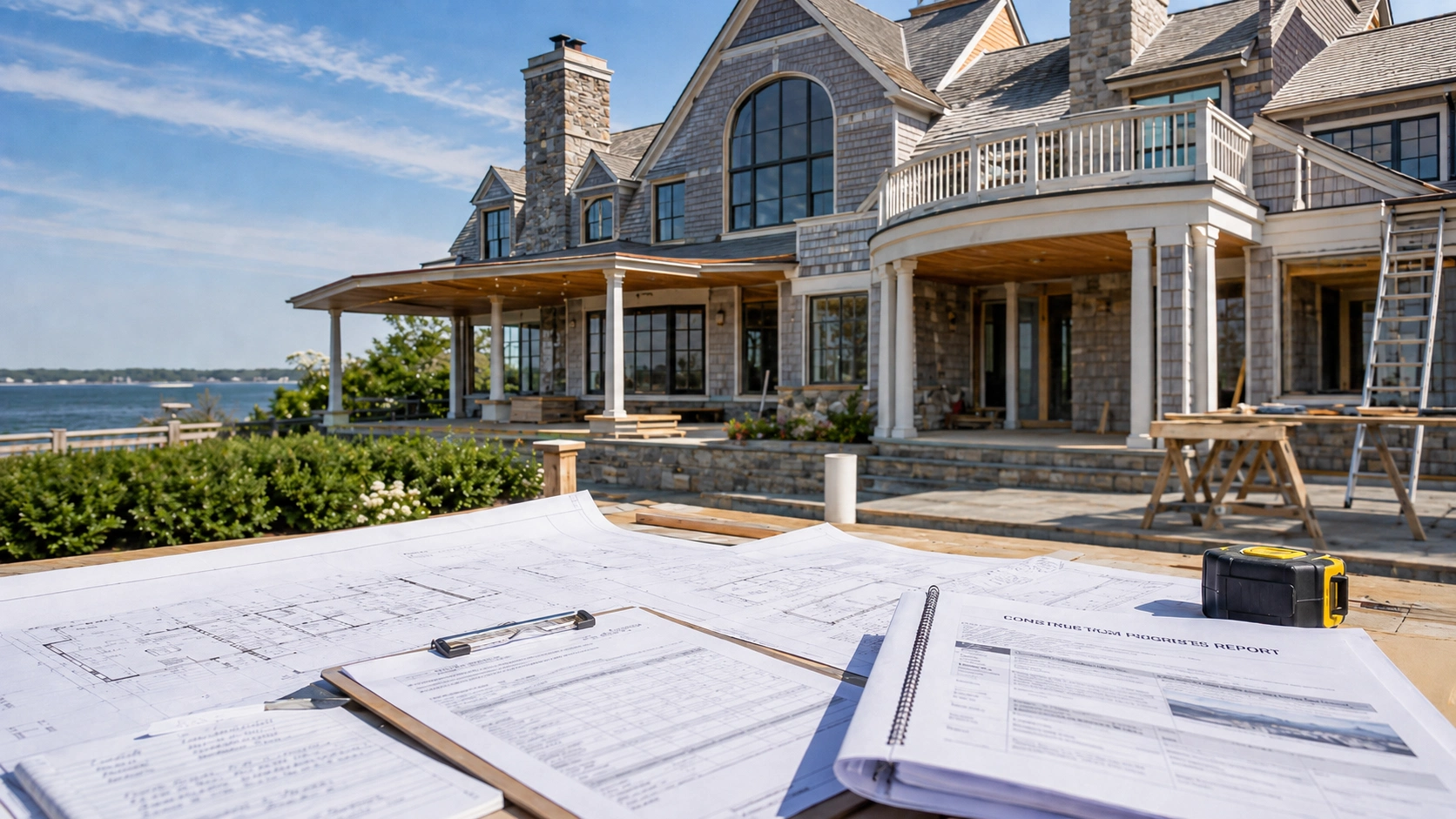
A construction progress report is a periodic summary, typically weekly during active construction, that covers work completed, work planned next, schedule status, budget status, and any issues that need the homeowner’s attention. It exists so decisions get made on where the project actually stands right now, not on outdated information.
This guide covers what belongs in every report, how to read a schedule and budget status at a glance, what makes photo documentation actually useful, and how often reports should go out.
Key Takeaways
- A construction progress report is a periodic summary, typically weekly during active construction, covering work completed, work planned next, schedule status, budget status, and any issues needing the homeowner’s attention.
- A short executive summary at the top, answering whether the project is on schedule and on budget in a few sentences, is what most owners actually read first.
- A red, amber, green status for schedule and budget gives an at-a-glance read on project health before anyone reads the supporting detail.
- Dated, organized photos tied to specific areas of the home let an owner verify progress without a site visit, especially useful for owners splitting time between the Hamptons and another home.
- A progress report and a payment application should always tell the same story about where the project stands; a mismatch between the two is a signal worth investigating.
- Consistency in format and timing, the same sections, the same day each week, is what makes reports genuinely useful over the life of a project rather than a formality.
What Belongs in Every Progress Report
A useful progress report follows the same structure every cycle, so an owner can find what they’re looking for without hunting through a differently organized document each time. This consistency is part of day-to-day project oversight, not a separate task bolted onto it.
The table below breaks down the sections a complete report typically includes.
| Section | What It Covers |
| Executive Summary | A few sentences on whether the project is on schedule and on budget |
| Work Completed | What was finished during the reporting period, organized by area |
| Work Planned Next | What’s scheduled for the upcoming reporting period |
| Schedule Status | Planned versus actual progress against the master schedule |
| Budget Status | Approved budget, costs to date, and any open change orders |
| Issues and Risks | Anything needing the homeowner’s attention or a decision |
The Executive Summary: Answering the Question First
Most readers never get past the first few sentences of a progress report, which is exactly why the executive summary matters more than any other section. It should answer the two questions every homeowner actually has: are we on schedule, and are we on budget, before any supporting detail follows.
A good executive summary takes under thirty seconds to read and doesn’t bury a problem in qualifying language. If the project is behind schedule or trending over budget, that fact belongs in the first sentence, not somewhere in the third paragraph.
A useful test for any executive summary: could someone who only reads those first few sentences still make an informed decision if asked to? If the answer is no, the summary is hiding detail that belongs at the top rather than several paragraphs in.
Tracking Schedule and Budget Status Together
Schedule and budget status are reported together because they’re rarely independent of each other: a delay usually has a cost implication, and a cost overrun often has a schedule cause. Many reports use a simple red, amber, green status to communicate this at a glance, which is a standard practice within transparent construction management:
- Green: on schedule and on budget, no action needed from the homeowner.
- Amber: a minor variance or an emerging risk that’s worth monitoring but not yet urgent.
- Red: a significant delay, budget overrun, or unresolved issue that needs the homeowner’s input now.
This status should never be softened to avoid an uncomfortable conversation. An amber or red status delivered early, with an explanation, is far more useful than a green status that turns out not to have been accurate.
Photos and Documentation That Actually Help
Photos are most useful when they’re dated, tied to a specific area of the home, and taken from a consistent angle each time, so progress in one week’s photo can be compared directly to the next. A folder of undated, unlabeled site photos is far less useful than a smaller set organized by room or system.
For owners splitting time between the Hamptons and another home, this kind of documentation is often the primary way they actually see the project between visits. Treating photo documentation as a core part of the report, not an afterthought attached to the email, reflects how much owners actually rely on it.
A weekly set of ten to fifteen well-chosen photos, covering whatever changed most that week, communicates more than fifty unsorted images from a phone camera roll. Quality and organization matter more than volume.
How Often Reports Should Go Out
Weekly reporting is standard during active, fast-moving construction phases, when conditions change quickly enough that a longer gap between updates leaves real blind spots. Some projects shift to biweekly or monthly once the pace slows during finish work, where changes are more incremental.
Reporting cadence often shifts one more time at the very end of the project, during final project handover, when punch list status and closing documentation become the focus rather than ongoing construction milestones.
Things to Know
- Weekly reporting is standard during active, fast-moving phases; some owners move to biweekly or monthly once a project reaches steadier finish work.
- A report that hides or downplays a schedule slip damages trust more than reporting it early with a plan to address it.
- Photos organized by location and dated consistently are far more useful over time than a general folder of site pictures without context.
- A progress report should reconcile with the current payment application; if the two disagree about what’s complete, that discrepancy needs resolving before either is finalized.
- Daily site logs, kept by whoever is supervising the site, are what a weekly or monthly report actually gets built from, rather than being reconstructed from memory.
- For an owner splitting time between the Hamptons and another home, a consistent report format matters more than length; the same section order every week is easier to scan than a longer report that changes structure each time.
Frequently Asked Questions
How often should I receive a construction progress report?
Weekly is standard during active construction; some projects shift to biweekly or monthly once the pace slows during finish work.
What matters most is consistency: the same reporting day and the same format each cycle make it easy to compare one period to the next and spot a trend before it becomes a problem.
What’s the difference between a progress report and a payment application?
A progress report summarizes overall status, schedule, budget, and issues, while a payment application is a formal request for payment tied to specific completed line items.
The two should tell a consistent story about where the project stands. If a payment application shows a line item as complete but the progress report doesn’t mention it, that’s worth reconciling before either document is finalized.
What does a RAG status mean in a progress report?
RAG stands for red, amber, and green, a quick visual status for schedule and budget: green means on track, amber flags an emerging risk, and red means an issue needs the homeowner’s attention now.
This kind of at-a-glance system lets a busy homeowner get the headline before reading the supporting detail, which matters most when a report needs to be read in a few minutes rather than studied line by line.
Should a progress report include bad news, like delays?
Yes, and a report that hides or downplays a delay tends to damage trust more than the delay itself.
Owners generally find out about a schedule slip eventually. Learning about it early, with a clear explanation and a plan to address it, is a very different experience than discovering it after the fact.
Who is responsible for preparing the progress report?
The construction manager or general contractor’s project manager typically prepares the progress report, often compiled from daily site logs kept by whoever is supervising the site.
On projects with an owner’s representative involved, that person may also review or contribute to the report as an independent check before it reaches the homeowner.
Staying Informed Without Standing on Site
A well-built progress report is what lets a homeowner stay genuinely informed about a project without needing to visit the site every week to see it for themselves.
Hamptons Luxury Design + Construction issues structured, consistent progress reports as a standard part of construction management across Southampton, East Hampton, Sag Harbor, Water Mill, and the surrounding villages, so owners always know exactly where a project stands on schedule and on budget.