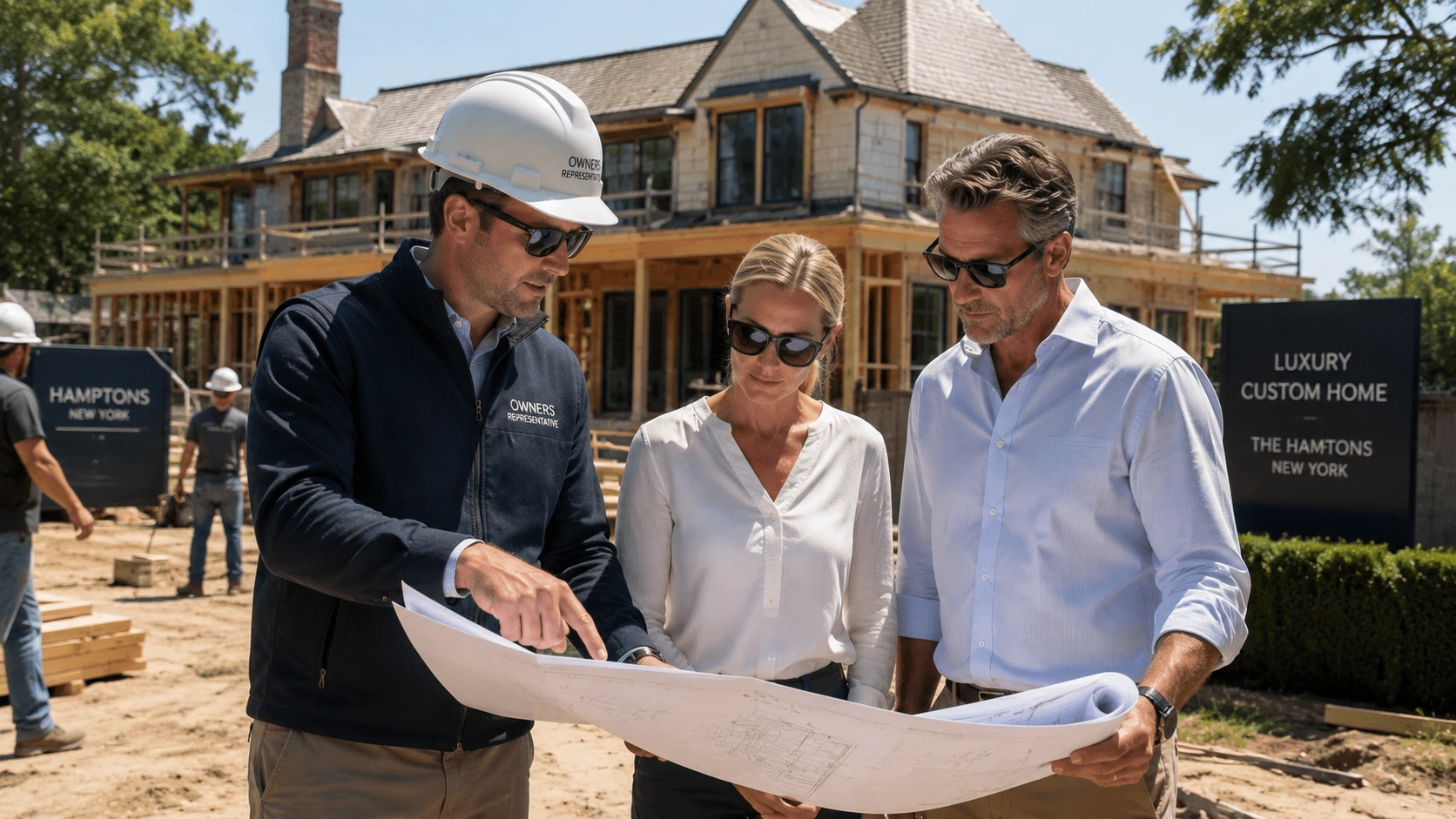
Managing a luxury home project in the Hamptons from a distance is not the same as being present. Decisions happen quickly on a busy job site. Invoices arrive on a schedule that doesn’t wait for a homeowner to review them between client meetings in the city. And the gap between what a contractor bills and what’s actually been completed on a given day can be significant, if no one is watching closely enough to catch it.
An owner’s representative is the person watching. Their job is to act as your advocate across every phase of a project, from design review through final inspection, with no stake in the construction contract and no obligation to anyone except you. For high-net-worth homeowners managing second homes, estate renovations, or complex builds from outside the Hamptons, it is one of the most practical protections available.
What an Owner’s Representative Actually Does
An owner’s representative is a construction professional hired by the homeowner to represent their interests throughout a project. They don’t design the home, and they don’t build it. Their role is to oversee the people who do, on your behalf, and to make sure that every decision made during design and construction aligns with your goals, your budget, and the standards you set at the outset.
In practice, that means attending design meetings and flagging concerns before drawings are finalized. It means reviewing the general contractor’s schedule against actual site progress and identifying delays early rather than discovering them at the end of a phase. It means auditing payment applications before funds are released, verifying that the work billed has actually been completed and is consistent with the contract.
It also means being your voice in rooms you can’t be in. When the architect and contractor disagree on how a detail should be resolved, when a subcontractor proposes a substitution that wasn’t in the original specification, when a change order arrives that needs a second set of eyes before you sign it, your owner’s representative handles those moments with the technical knowledge to respond correctly rather than deferring to whoever is most persuasive.
The scope varies by project. Some homeowners engage an owner’s rep from the earliest design conversations. Others bring one in for the construction phase, when the pace of decisions and expenditure is highest. Both approaches are valid, though earlier involvement tends to produce better outcomes.
How Owner’s Representation Differs From Construction Management
Owner’s representation and construction management are related services, and the terms are sometimes used loosely enough that the distinction gets lost. For a Hamptons homeowner, understanding the difference matters before deciding which one your project needs.
A construction manager is typically engaged to oversee the build itself: assembling and coordinating the trades, managing the schedule, controlling costs, and ensuring the work meets quality standards. In a residential context, a construction manager often sits closer to the builder’s side of the equation, directing the work rather than simply watching it.
An owner’s representative sits entirely on your side. They don’t manage the trades directly. Their job is to monitor the people managing the trades, on your behalf, and to make sure that your interests are protected in every decision and transaction. Where a construction manager focuses on executing the project, an owner’s representative focuses on protecting the owner across the project.
Some homeowners use both, particularly on large estate builds where the scope of construction is complex enough to warrant a dedicated manager on the contractor’s side and an independent advocate on the owner’s side. On smaller renovation projects, an owner’s representative alone is often sufficient, especially when a capable general contractor is already in place.
The Situations Where Owner’s Representation Makes the Most Sense
Not every project requires an owner’s representative. A straightforward kitchen renovation managed by a trusted contractor you’ve worked with before, with regular access to the property, may not need additional oversight. The calculus shifts when one or more of these conditions is present.
The most common is absentee ownership. The Hamptons is, for most of its high-end client base, a second home market. Many homeowners managing a renovation or new construction are based in New York City, Connecticut, or further afield, and cannot be on site regularly. A property in East Hampton or Water Mill on an 18-month build schedule needs someone present and accountable in a way that occasional weekend visits don’t allow.
Project complexity is the second. A ground-up estate with multiple trade packages, a design-build team, and a permitting process touching the Conservation Board, the Zoning Board of Appeals, and the local building department is a project with a lot of moving parts and a lot of places for things to go quietly off track. An owner’s rep provides a consistent point of oversight that doesn’t depend on your availability.
Limited construction experience is the third. High-net-worth homeowners are often highly sophisticated in their professional fields and rarely expert in reading construction documents, evaluating change orders, or understanding when a payment application is asking for more than the work warrants. An owner’s representative fills that knowledge gap without requiring the homeowner to develop expertise they shouldn’t need to have.
What an Owner’s Representative Does on Site and Off
The practical work of owner’s representation divides naturally between what happens on the property and what happens off it.
On site, an owner’s rep visits the project on a regular cadence, often multiple times per week during active construction phases, less frequently during design or permitting. Those visits aren’t social calls. They’re structured reviews: comparing observed progress against the schedule, verifying that work matches the specifications and approved drawings, documenting conditions with photos and written notes, and identifying anything that needs to be corrected before it’s buried in a wall or covered by a finished floor.
The invoice audit function is where many homeowners are most surprised by the value an owner’s rep provides. On a luxury Hamptons project, contractor payment applications can run to six or seven figures per draw. An owner’s representative reviews each application in detail before any funds are released, confirming that the percentage of work claimed as complete matches what’s actually been done on site. This is not a formality. It is one of the most concrete financial protections available to a homeowner on an active build.
Off site, the work is equally active: reviewing design documents and flagging constructability issues before they reach the field, attending project meetings and keeping detailed records of decisions made, managing correspondence with the architect, contractor, and consultants, and reviewing change orders with a clear recommendation before a homeowner is asked to approve additional expenditure.
What to Look for When Hiring an Owner’s Representative in the Hamptons
Owner’s representation is a licensed professional service, and not all firms that offer it bring the same depth to residential luxury projects. A few things are worth assessing before you engage anyone.
Local knowledge is not optional. The regulatory environment in the Hamptons, the relationships with local building departments, the understanding of what a village Architectural Review Board will and won’t approve, these are not things a generalist project manager can quickly acquire. Your owner’s rep should have direct experience working in the specific villages your project touches.
Residential versus commercial background matters. Many owner’s rep firms come from commercial or institutional construction, where the scale and dynamics are different. A luxury residential project on the East End has its own rhythms: seasonal scheduling pressures, the specific craftsmanship expectations of high-end homeowners, the discretion required when the client is a private individual rather than a corporate entity. A firm that has worked primarily in commercial construction may not be calibrated for those conditions.
Fee structures vary. Owner’s representative fees typically run between one and five percent of total construction cost, or on a flat monthly retainer, depending on the scope and duration of engagement. Ask any firm you consider how they structure fees and what services are included at each level, so the engagement is clearly defined before it begins.
Finding the Right Fit for Your Hamptons Project
A well-run luxury home project feels different from the homeowner’s side. Decisions arrive with clear recommendations. Invoices come with documentation you can actually understand. Site visits produce written reports rather than verbal reassurances. That level of clarity is what a skilled owner’s representative provides, and it is what the complexity of a Hamptons project, the regulatory environment, the seasonal calendar, the distance from primary residences, tends to demand.
Hamptons Luxury Design + Construction offers owner’s representation services across Southampton, East Hampton, Sag Harbor, Water Mill, and the surrounding villages, working alongside architects, designers, and contractors to protect your interests from the first design review through the final walkthrough. If you’re assembling a team for an upcoming project or looking for independent oversight on one already underway, the portfolio and services page are useful starting points.
Frequently Asked Questions
Do I need an owner’s rep if I already have a general contractor?
Having a general contractor doesn’t eliminate the need for an owner’s representative. A GC manages the build and is responsible for delivering the project, but their obligations run to the contract, not exclusively to your interests when the two diverge. An owner’s representative has no stake in the construction contract and no interest in the outcome except your satisfaction. The two roles are complementary, not interchangeable, and on complex projects many homeowners benefit from having both.
How much does an owner’s representative typically charge?
Owner’s representative fees for residential luxury projects typically range from one to five percent of total construction cost, depending on scope, project duration, and the level of involvement required. Some firms offer flat monthly retainer arrangements, which can be more predictable for longer engagements. The fee should be weighed against the risk being managed: on a multi-million-dollar Hamptons build, the cost of missed invoices, unreviewed change orders, or undetected construction defects typically exceeds the owner’s rep fee many times over.
Can an owner’s rep help if my project is already underway?
Yes. While earlier engagement produces better outcomes, an owner’s representative can add meaningful value at any stage of a project. On an active build, the most immediate contributions are invoice auditing, schedule monitoring, and change order review. On a project that has run into problems, an experienced owner’s rep can assess where things stand, identify what documentation is missing, and help structure a path forward. Don’t let timing prevent you from bringing in oversight that your project genuinely needs.
What’s the difference between owner’s representation and construction management in a residential project?
In residential practice, a construction manager typically directs the build itself, coordinating trades, managing the schedule, and overseeing quality on site. An owner’s representative monitors the construction manager and contractor on the homeowner’s behalf, sitting entirely on your side of the project rather than the builder’s. The key distinction is where their accountability lies. A construction manager answers to the build. An owner’s representative answers only to you.
How often will an owner’s rep visit my Hamptons property during construction?
Visit frequency depends on the project phase and the scope of the engagement. During active construction, particularly during foundation work, framing, MEP rough-ins, and finishes, site visits often occur multiple times per week to maintain meaningful oversight. During slower phases like permitting or design development, visits may be less frequent. Any firm you consider should be able to describe their standard site visit cadence for a project of your scale and explain how they document and report on each visit.