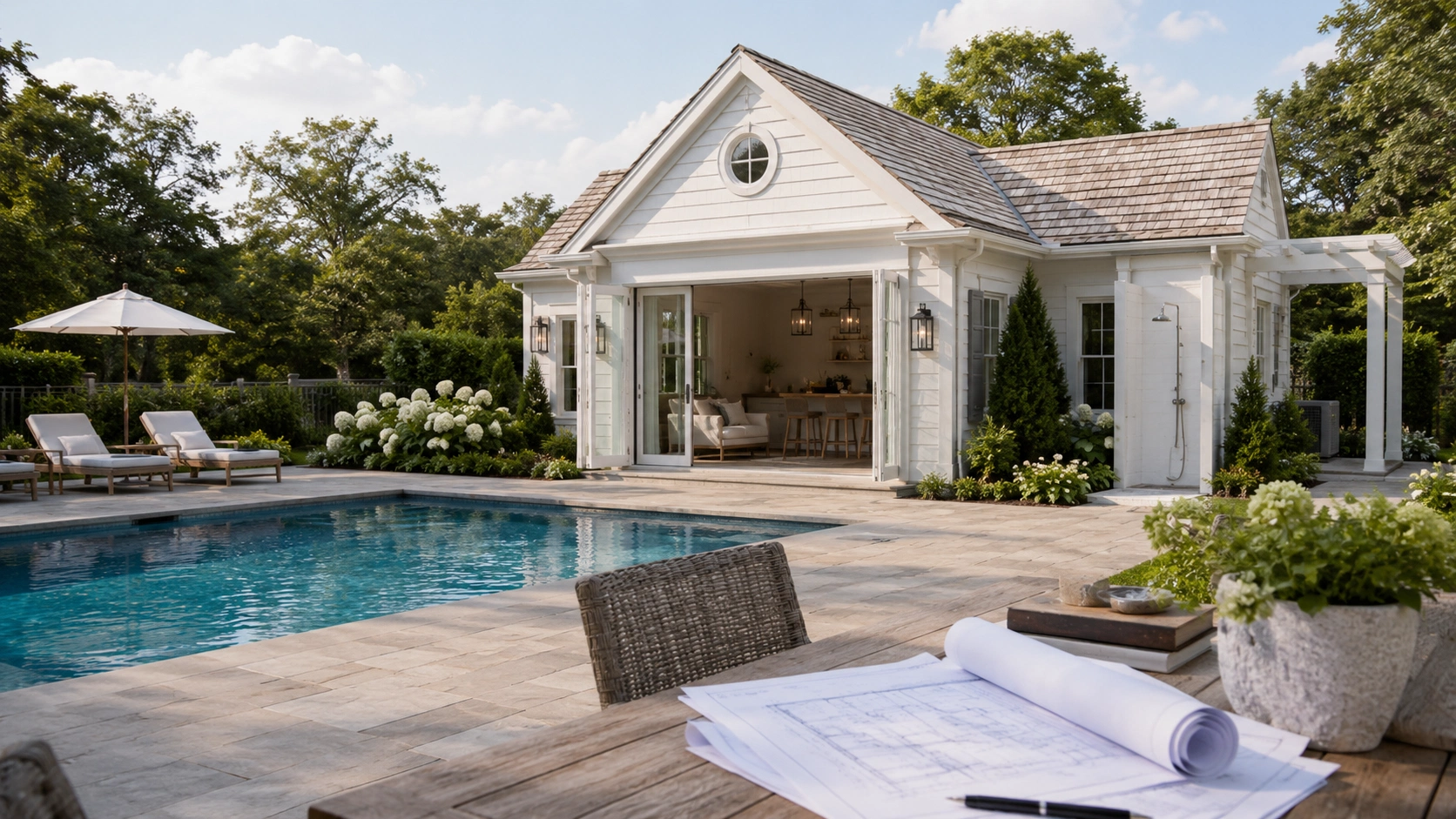
In Southampton, the pool house has evolved from a simple changing room into a sophisticated secondary structure that serves as the centerpiece of outdoor entertaining. However, as these buildings become more complex, they enter a highly regulated territory of local zoning and building codes. For homeowners in both the Town and Village of Southampton, the successful delivery of a resort-style accessory building requires a careful balance between luxury utility and strict adherence to municipal constraints regarding occupancy and plumbing.
The Definition of Accessory Use
Zoning in Southampton is built on the principle of “principal use,” meaning an accessory building like a pool house must remain subordinate to the main residence. Local code dictates that an accessory structure cannot be permitted on a lot unless a principal building—the main house—already exists with a valid Certificate of Occupancy.
A critical distinction in Southampton is the prohibition of “second dwellings.” To remain a legal accessory structure, a pool house cannot contain all the elements required for independent living. Specifically, while plumbing for a bathroom or a bar is often permitted, the inclusion of a full kitchen—defined by the presence of a stove or oven—is generally prohibited. These regulations are designed to prevent the conversion of pool houses into illegal rental units or guest houses without the appropriate special permits and density reviews.
Navigating Plumbing and Health Department Approvals
While many Southampton pool houses feature high-end bathrooms and outdoor showers, the introduction of plumbing triggers a secondary layer of oversight: the Suffolk County Department of Health. Because much of Southampton relies on on-site sanitary systems, any increase in “fixture count” must be reviewed to ensure the septic system can handle the additional load.
For projects involving complex plumbing—such as a pool house with a full bathroom and a wet bar—the Building Department requires a red-stamped survey from the Board of Health. This is often the longest lead-time item in the permitting process. We coordinate with sanitary engineers early in the design phase to calculate flow rates and, if necessary, upgrade the property’s IA (Innovative and Alternative) septic system to accommodate the new resort-style amenities.
Setbacks, Coverage, and the Pyramid Height Law
The placement of a pool house is governed by specific setback requirements that are often more restrictive than those for the main house. Accessory buildings are typically prohibited in the required front or side yards and are subject to the “20% rule,” which limits the total coverage of the required rear yard.
Furthermore, all structures in Southampton must comply with the Pyramid Height Law. This regulation creates an invisible “envelope” that slopes inward from the property lines; if a pool house is designed with high gabled ceilings to create a sense of interior volume, it must be positioned far enough from the property boundary to remain beneath this geometric plane. We utilize 3D massing studies during the design phase to ensure that the building’s height and location are optimized for both aesthetic impact and code compliance.
The Infrastructure of Outdoor Entertaining
A resort-style pool house often serves as the hub for the estate’s outdoor technology. This includes everything from the pool’s filtration and heating controls to integrated sound systems and high-capacity Wi-Fi extenders. In 2026, we are seeing an increased focus on “silent infrastructure,” where the pool’s mechanical equipment is housed in sound-insulated “bunkers” within or adjacent to the pool house to ensure the patio remains a tranquil environment.
Additionally, the energy demands of a heated pool and a fully equipped cabana require a robust electrical plan. We manage the installation of sub-panels dedicated to the pool area, ensuring that high-draw items like heat pumps and outdoor kitchen appliances do not strain the main house’s electrical service. By centralizing these controls within the pool house, we provide the owner with a streamlined interface for managing the entire outdoor environment.
Safety and Barrier Requirements
In Southampton, the pool house itself often acts as a portion of the “permanent barrier” required by the New York State Residential Code. Any door providing direct access from the pool house to the pool area must be equipped with an alarm that produces an audible warning when the door is opened.
These safety regulations are non-negotiable and are a primary focus during the final inspection for a Certificate of Occupancy. We ensure that all hardware—including self-closing and self-latching mechanisms on gates and doors—is integrated into the architectural design of the pool house from the outset. This ensures that the building meets the highest safety standards without sacrificing the clean lines of a luxury retreat.
Conclusion
Building a pool house in Southampton is an exercise in precision. It requires the ability to navigate a multi-layered regulatory environment involving the Building Department, the Planning Board, and the Department of Health. When managed correctly, these structures provide a significant increase in both the utility and the value of an estate, creating a dedicated space for relaxation that functions with the efficiency of a world-class resort.
Success is found in the early identification of zoning constraints and the proactive management of the permitting timeline. By respecting the definitions of accessory use and prioritizing the technical infrastructure of the site, a property owner can create a pool house that is as resilient and compliant as it is beautiful. This disciplined approach ensures that the final structure serves as a seamless extension of the Southampton lifestyle for years to come.